The pitch for smart home gear is that it pays for itself. A video doorbell that lets you answer the door from work. A thermostat that turns the heat off when you leave. The marketing does the math in your favor: convenience, security, energy savings. The invoice tells a different story, and the monthly one is where most people get surprised.
Here are honest numbers before you buy anything. A video doorbell runs $80 to $250, a smart lock $150 to $350, a smart thermostat $150 to $300, a leak sensor $50 to $200, a smart plug $15. Then the monthly plans: cloud video storage at $4 to $12, AI detection packages at $5 to $20, monitoring higher still. Built the way the ads imagine, a starter smart home runs $600 to $1,000 upfront plus $10 to $25 a month: $1,800 to $3,000 over five years for the privilege of turning on a lamp from your phone.
Do the five-year math first, not the sticker-price math
Every “free” smart home device is a loan against your future. The usual bait is a doorbell given away “free” with a $10-a-month plan for 36 months: $360 for a device you could have bought for $120. The plan is not a discount, it is a mortgage.
- Add the device price to (monthly fee times 60). A $180 doorbell on a $12 monthly plan is $900 over five years, against $180 for the free tier.
- Decide what the paid tier buys. Storage is the most defensible fee, because it costs the company money per customer. AI summaries and person detection are marketing features that get folded into a cheaper plan or deleted.
- Subtract what it saves you, which is usually nothing. Smart plugs do not lower your electric bill, a smart lock does not lower your insurance premium, and a video doorbell rarely reduces theft.
If a product cannot show you a number where savings beat the cost, you are buying convenience. That is a legitimate reason to spend, as long as you price it that way.
The risk nobody puts in the box: the company, not the device
Here is the part the packaging ignores. Most of these products are not standalone appliances. They are front ends for somebody else’s cloud, and that company is the point of failure. In 2023 the servers behind a major camera brand failed for hours and thousands of units went dark. Doorbell makers have discontinued older models and cut features from firmware. Companies get acquired, fold a product line, or stop issuing security patches. When that happens a cloud-dependent device does not get dumber. It stops doing anything at all.
The test is cheap: turn off the internet and see what still works. A thermostat with the schedule stored on the device still runs it, and a smart plug running local schedules still switches the lamp. A doorbell that streams video through a vendor’s servers does nothing without them, and a lock that checks codes against a vendor’s cloud starts refusing valid codes if that service dies.
Local-control hubs are the fix, and they are cheaper than people assume. A hub that runs on your own hardware, such as the open-source Home Assistant project, keeps your devices working when the internet goes out and when the manufacturer loses interest. It costs an afternoon of setup. If you do nothing else from this article, at least know this option exists.
Smart locks: the most expensive convenience in the house
A good mechanical deadbolt costs $40 to $60 and lasts decades. A smart lock costs three to five times that and can lock you out of your own home. Three failure modes to price in: the battery dies and with it the keypad on some models, the temporary passcode you gave a contractor expires and you never re-code the cleaner, and your lease or insurer makes you remove the whole thing before you move. Buy one with a physical key override that works with the app dead and the battery pulled, and test that override before you need it.
Where a smart device can genuinely earn its keep
A programmable thermostat is the strongest case, and the savings are documented: the Department of Energy puts smart and programmable thermostats at roughly 10 to 12 percent of heating and cooling costs, more when your habits are the opposite of the previous owner’s. On a $300 annual heating bill that is $30 a year against a $200 device, a long payback. A $60 basic thermostat captures much of the same savings, and the fancier models only earn their premium if you also use occupancy sensing, a utility demand-response program that pays you to let it shift your AC, or rebates of $50 to $200 tied to specific model numbers.
The second is a leak sensor. Water damage is the most expensive thing that happens quietly in a house, and a $60 sensor that alerts you is cheap insurance. Many leak sensors work locally with no subscription at all, because the alert goes to your hub instead of to a marketing funnel.
The privacy bill nobody prices
A camera and a microphone on your front door is a standing invitation. Manufacturers have started requiring account sign-in for devices to keep functioning, a policy change that can strand a perfectly good unit in a household that will not create an account. Footage stored in a vendor’s cloud sits on somebody else’s computer under their retention policy, subject to how they answer a subpoena.
Concrete moves: pick a camera that records locally to an SD card or a network video recorder; cover the lens or mic from inside the door if you are not using them; give the device its own email address and a unique password with two-factor on; and look for a written security-update support window. The US Cyber Trust Mark is a voluntary label where a vendor commits to that window in advance.
The buying checklist
- Five-year total cost, not sticker price
- Does it still work with the internet out?
- Does it work with no account, or is sign-in mandatory?
- A physical key or manual override on anything that secures an entrance
- A local recording option for any camera
- A written security-update support window
- Every paid feature you would actually use, named out loud
The bottom line
Most smart homes are a convenience purchase dressed up as a savings purchase, and the recurring fee is where the honest math lives. Favor devices that schedule and sense on their own, spend on a thermostat only if you have a habit worth breaking, skip the video doorbell if nobody is ever going to answer it, and keep a spare key in a drawer.
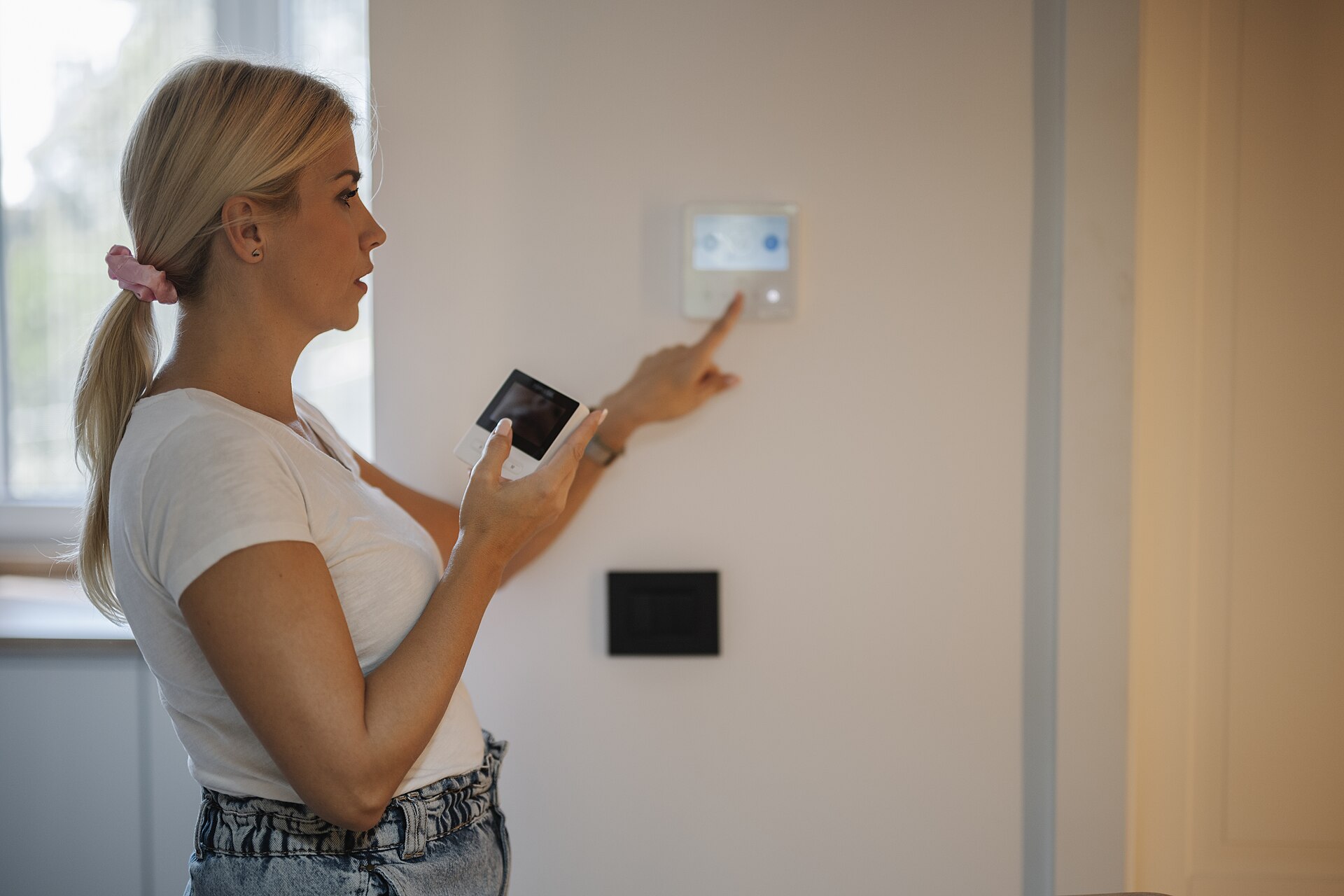
Image: “Woman adjusts smart home thermostat while holding smartphone in home setting” by Shixart1985, released under CC BY 2.0 via Wikimedia Commons.