Ben & Jerry’s ice cream in the tub is still great, but the brand’s newest chocolate-covered ice cream bar on a stick?
“It ain’t the same,” Ben Cohen, the company co-founder, told the Guardian. Sure, the chocolate coating is still thick enough, but the ice cream itself is “kinda fluffy”, Cohen said – an insult in the ice cream world that suggests extra air was added to cut costs.
The criticism is surprising coming from Cohen, who opened his eponymous ice cream shop in Burlington, Vermont, with childhood friend, Jerry Greenfield, in 1978. But it’s perhaps an apt metaphor of how he feels amid a simmering fight to take back Ben & Jerry’s from a parent company he says has silenced the brand’s trademark activism.
For Cohen, 75, the battle is legal and existential. Ben & Jerry’s social and economic value was protected for decades, he says, by an independent board with final say on the brand’s voice, values and ice-cream quality.
But that independence has all but disappeared, Cohen said. In November 2024, Ben & Jerry’s sued parent company Unilever, claiming it was blocked from voicing support for Gaza, and accusing Unilever of breaching their deal agreement. The lawsuit is still making its way through federal court.
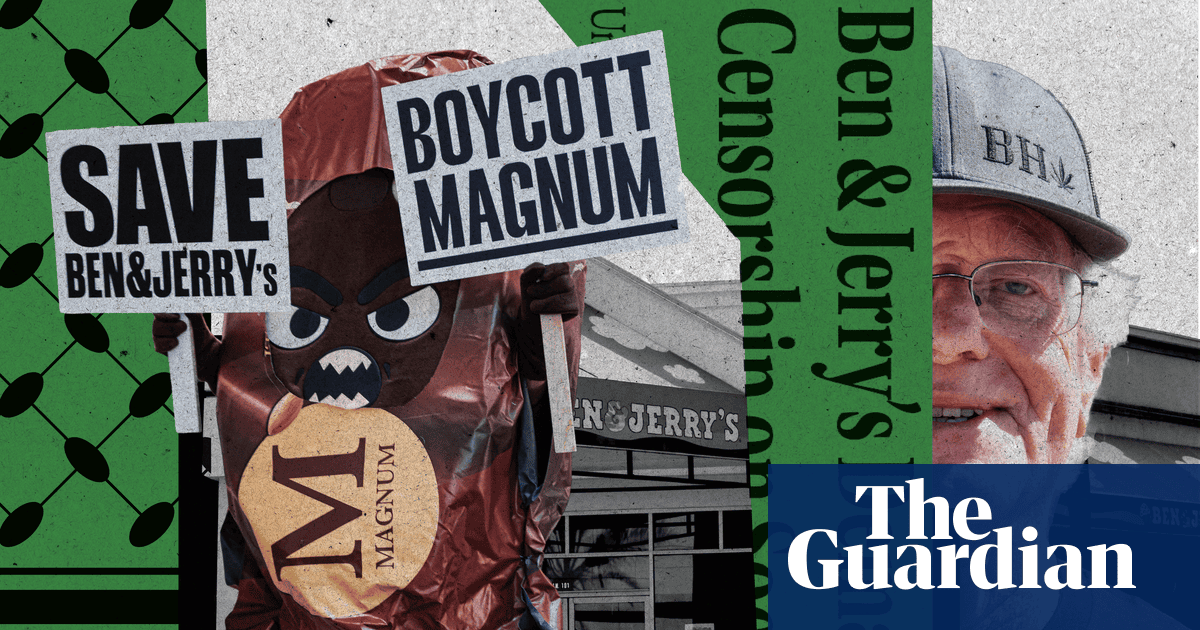
In September 2025, after Unilever spun off its ice cream brands into the Magnum Ice Cream Company, Cohen started his campaign to “Free Ben & Jerry’s” – asking Magnum to sell the brand so it can be independently owned and operated.
Social activism is a core part of why people buy Ben & Jerry’s, Cohen says. “What consumers want above all is authenticity and attitude,” he said.
Ben & Jerry’s could be valued at $1bn or more, Cohen estimates, but says Magnum won’t give him or potential investors numbers that could help value it more accurately.
Magnum has insisted Ben & Jerry’s is not up for sale, so Cohen is amping up his campaign. In recent weeks, Cohen has started calling for a boycott of Magnum’s other brands, including Yasso, Breyers, Talenti and Klondike, with the idea that tanking the company’s overall sales will pressure it to sell back the company.
“We didn’t want it to have to come to this,” he said of the boycott, but Magnum is “destroying a brand” that stands for values its customers believe in.
What Cohen is trying to do – force an $11bn conglomerate into divesting a star brand – is highly unusual, and unlikely to succeed, some industry and management experts predict.
“Most boycotts fail because people get distracted,” said Maurice Schweitzer, a management professor at the Wharton School at the University of Pennsylvania. US and European consumers just may not have the long-term attention span for the sustained collective action that it would take to pressure management, Schweitzer said.
But Cohen believes the company’s loyal followers are on his side.
“Consumers want to vote with their dollars,” he said, insisting that support for the brand must continue. “We want Ben & Jerry’s to remain strong because we plan on eventually owning it.”
The flavors of conflict
It’s been nearly three decades since Cohen and Greenfield sold their company to Unilever for $326m in 2000. The unique deal was built around an independent board and lauded by the Wharton School for preserving the company’s pledge to try to “make the world a better place” while also committing to making great ice cream and turning a profit.
Under Unilever, Ben & Jerry’s was vocally supportive of social issues. The company criticized George W Bush’s war in Iraq, was a pioneering supporter of same-sex marriage, and called to “dismantle white supremacy” after George Floyd was murdered.
But now, the divide between the brand’s founders and the company’s corporate owners is deep and bitter.
Cracks first opened after an independent board overseeing the company said in 2021 that selling Ben & Jerry’s ice cream in occupied Palestine was “inconsistent with our values”, sparking outrage in Israel. Unilever sold off the Israeli trademark to a local businessman who is now selling a “Milk & Honey” flavor.
The board first sued Unilever in 2024, accusing the company of silencing its activism over Palestine, including vocal support for Gaza and calls to stop US aid to Israel.
Then in 2025, Unilever ousted David Stever, the Ben & Jerry’s CEO, in a move Ben & Jerry’s said was designed to stifle its social mission, including a board-approved plan to sell a watermelon flavor to support Palestine that was quashed.
Co-founder Greenfield quit the board soon after, stepping away from the company for the first time in 50 years, saying it had lost its independence. Currently, the board has just two Unilever veterans after Magnum imposed new term limits.
Though the campaign to buy back Ben & Jerry’s has been led by Cohen, Greenfield said in his resignation letter that leaving the board was one of the “hardest and most painful decisions” he has ever made.
“It is profoundly disappointing to come to the conclusion that that independence, the very basis of our sale to Unilever, is gone,” he said. “If the company couldn’t stand up for the things we believed, then it wasn’t worth being a company at all.”
Earlier in July, Ben & Jerry’s philanthropic foundation said it was forced to close after Magnum cut its funding. Magnum says an investigation found “governance and conflict-of-interest issues”.
In an interview with the Guardian, Magnum’s chief corporate affairs and sustainability officer Victoria McKenzie-Gould said it invited trustees of the foundation to partner on a stronger corporate governance framework, but they declined.
“Our focus remains where it belongs: on supporting the Ben & Jerry’s team and its three-part mission while making great ice cream and campaigning on the causes the brand cares about – and the team is doing a fantastic job,” McKenzie-Gould said.
‘Not for sale’
Through Cohen’s months-long fight to buy back his company, Magnum has said it has no intention of selling.
“Ben is a great campaigner, but Ben & Jerry’s is not for sale, and we are confident in the future because Ben & Jerry’s is thriving as part of the Magnum Ice Cream Company,” McKenzie-Gould said.
Magnum doesn’t break out sales by brand, but called Ben & Jerry’s one of its “top four”, with 3% organic sales growth in 2025; about 35% of Magnum’s €7.9bn ($9.1bn) 2025 revenue came from the Americas, traditionally Ben & Jerry’s largest market.
Sales grew 9.2% in the second quarter, “powered by innovation”, Ben & Jerry’s CEO Jochanan Senf said on Thursday, adding that all three parts of the company’s mission – social, product and economic – must “thrive equally in a way that commands deep respect for individuals in and outside the company”.
Since it was acquired in 2000, Ben & Jerry’s “footprint has grown from four to over 40 countries, [and] revenue has grown more than fivefold,” McKenzie-Gould said. The company’s overall social mission has received €500m ($576m) from the parent – more than the original purchase price.
The brand has spoken out recently on “ICE; refugee support in Europe; cannabis justice and voting rights”, a corporate spokesperson for the Ben & Jerry’s brand told the Guardian, including a new flavor – Razz Up! – that encourages midterm voting.
The spokesperson disagreed with Cohen’s criticism of the new ice cream bars, saying the product was approved by the independent board in 2024 and used the same design standards as every product.
“More than one-third of bar buyers in the last year are completely new fans to Ben & Jerry’s,” Senf said with second-quarter results.
Cohen’s calls for a boycott comes as many Americans are angry at companies and frustrated over US policies. American support for Palestinians and criticism of Donald Trump have grown, and there’s a growing frustration with big companies over shoddy products and bad service.
But the headwinds for a successful boycott are stiff. There’s a war against “woke capitalism”, and shareholder support for environmental, social and governance resolutions has plummeted. Many of the social media platforms Cohen needs to spread his message are controlled by conservative billionaires, leaving him at the mercy of their algorithms.
“I do think this is going to get lost in the shuffle of so many other causes,” said Schweitzer.
Plenty of fans seem to think Cohen’s expectations are naive. “Did you really think a giant company wouldn’t exploit you? When has an international company ever had social values?” wrote Base_Art, a painter, on Instagram.
But Cohen has also gathered about 200,000 signatures and lots of encouraging social media messages. “Occasionally, I ate the vegan coffee Talenti,” former model Christie Brinkley recently wrote on Instagram. But without an independent board of directors, she said: “No more!”
Cohen acknowledges the hurdles, but says he believes long-time, loyal fans will help overcome them.
“I think that there’s millions of people who support Ben and Jerry’s and support its social mission,” Cohen said. “I’m going to take it until we win.”