The coupon trap
Every few months a “couponer” goes viral on TikTok showing a $4 grocery haul. The audience responds with awe, the algorithm rewards it, and the rest of us quietly conclude that we are bad at saving money. We are not. Those $4 hauls are usually built around loss leaders a store is already selling at cost, doubled up with manufacturer coupons, store rewards, and cashback apps the creator has spent months tuning. It is a part-time job that looks like a hobby, and the savings per minute are often worse than a part-time shift at minimum wage.
The good news is that the bulk of your grocery bill is not decided at the coupon stage. It is decided weeks earlier, in three choices: how often you eat out, what you put on the shopping list before you leave the house, and whether the store brand is actually worse. Fix those and most households can carve 20 to 30 percent off their food spend without cutting a single coupon.
Track two weeks before you change anything
You cannot shrink a number you have not measured. Spend two weeks writing down every dollar that goes toward food, including coffee runs, delivery fees, work lunches, and the snack aisle impulse. Most people are startled by the gap between what they think they spend and what they actually spend, and the gap is usually in eating out, not in the grocery aisle. Awareness is not a fix, but it tells you where to aim.
Categorize the spend into four buckets: groceries, restaurants, delivery, and convenience. Then set a realistic target for each. A common working split is roughly 60 percent groceries, 25 percent restaurants, 10 percent delivery, and 5 percent convenience, but your mix depends on whether you have kids, a partner with different hours, and how far you live from work. Pick the bucket that is biggest relative to your goal and start there.
Plan meals around what is already cheap
Every store runs a weekly loss-leader cycle. Chicken thighs, ground beef, eggs, bananas, in-season produce, and one or two pantry staples are priced below cost to get you through the door. Build two or three meals around those items each week and let the rest of your menu fill in around them. The meal plan does not have to be a spreadsheet. A note on the fridge with four or five dinner anchors is enough.
Eggs deserve a paragraph of their own. A dozen large eggs in mid-2026 still costs less than a single fast-food sandwich in most regions, and the protein-per-dollar math is hard to beat. If your household eats eggs, you can stretch almost any leftover vegetable into a frittata or a stir-fry and replace a $14 takeout order with a $3 dinner in about ten minutes of actual cooking.
Stop assuming the store brand is worse
Blind taste tests by publications ranging from Consumer Reports to America’s Test Kitchen have repeatedly found that store-brand products match or beat the name brand in roughly 60 to 70 percent of categories, often at 25 to 40 percent less. The categories where it almost always matters are olive oil, coffee, and chocolate, where origin and bean quality show up in the cup. In cereal, frozen vegetables, broth, canned beans, and basic dairy, the store brand is usually the same product in a different label, because many of them are co-packed in the same factories.
Switch one category per shop. Do a side-by-side taste test at home, and keep the switch if your family does not notice. By the end of two months you will have a personal list of items where the name brand earns its premium and items where it does not, and you can shop that list forever.
Bulk only buys you savings if you actually eat it
Costco and Sam’s Club have a real place in a budget, but the savings evaporate fast if you buy a five-pound bag of rice you never finish, a flat of seltzer you cannot physically drink, or fresh produce that spoils before the weekend. The honest test for any bulk purchase is whether you already buy the smaller version of the item at least twice a month. If you do not, the bulk version is not a discount. It is a future trip to the trash.
For pantry staples your household already burns through, warehouse pricing is genuinely meaningful. Toilet paper, paper towels, laundry detergent, rice, oats, and shelf-stable proteins all qualify. Fresh berries, fancy cheese, and anything your family is “trying to like” almost never do.
Use cashback apps without becoming their product
Ibotta, Fetch, and the various retailer apps have a legitimate 1 to 4 percent effect on a grocery bill when used casually. They become a problem when you let the offer dictate the cart, which is the same mistake people make with coupons. A $3 rebate on a brand of yogurt you would not otherwise buy is not $3 of savings. It is $3 of incentive to spend $7 you would not have spent.
The healthier habit is to shop the way you would shop without the app, then stack the app at checkout for whatever happens to match. You will still earn a few dollars a week, but you will not let the offers steer the menu or pull items you would never finish into the pantry.
Audit the cart at the door
Walk out of the store with the receipt in one hand and the cart in front of you, and before you put anything away, ask three questions: would I buy this again next week, did it replace a meal I would have bought out, and is there a unit price I should have compared at the shelf. Anything you would not buy again stays off the list next time. Anything that replaced eating out counts as a real win, even if it cost more than the cheapest possible alternative.
This is the unsexy part of saving on groceries. It is not a hack and there is no viral video in it. But it is how the households that actually keep their food budget under control do it, and over a year the compounding is significant.
The grocery bill is the most controllable line item in most personal budgets. You can negotiate your rent once a year. You can refinance a car loan every few years. You decide what goes in the cart every week. That weekly decision, repeated with a little more intention, is worth more than any coupon stack ever will be.
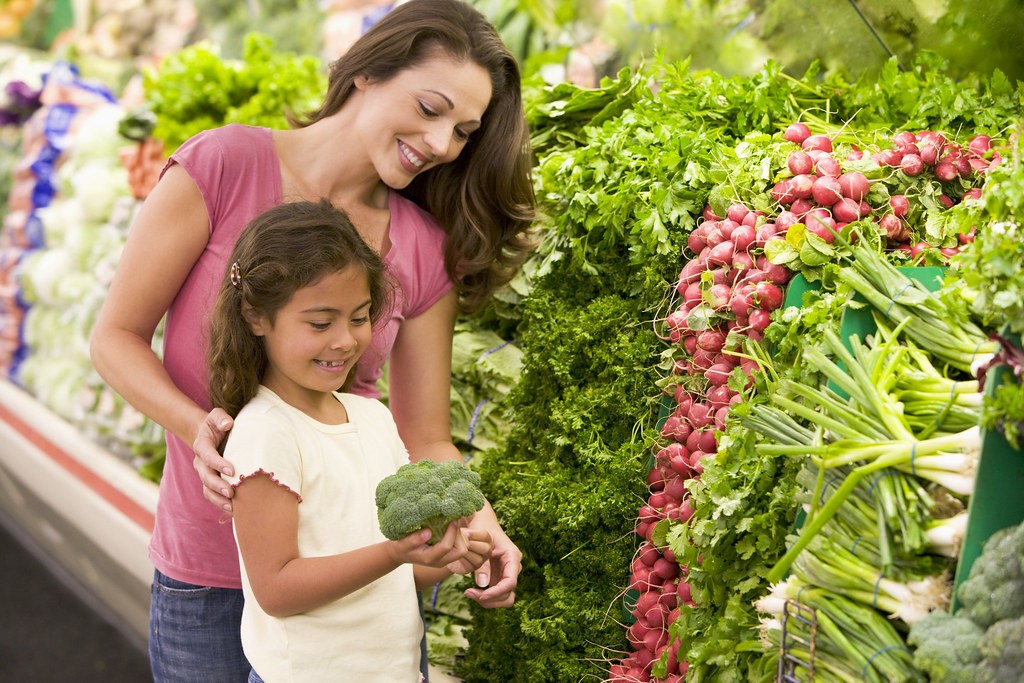
Featured image: “Mother and daughter shopping for fresh produce” by FNS Midwest, via Flickr. Public Domain.