Spain has deployed the military and police to its North African enclave of Ceuta after at least 34 people died trying to cross into the Spanish territory from Morocco by land and sea, according to the enclave’s president.
Spanish Prime Minister Pedro Sanchez on Friday visited the enclave, where he met security officials and regional authorities. He said about 60,000 people had entered Ceuta over the past few days – which is more than half the enclave’s population.
Recommended Stories
list of 4 itemsend of list
The surge has triggered political tensions across Europe with France announcing tighter checks at its border and Spain and Italy threatening new measures to curb migration, including calls by senior politicians to suspend Spain from the Schengen free-travel area. Here’s what we know:
What happened?
Thousands of people crossed into Ceuta on Thursday and continued arriving overnight into Friday, travelling by sea and over land.
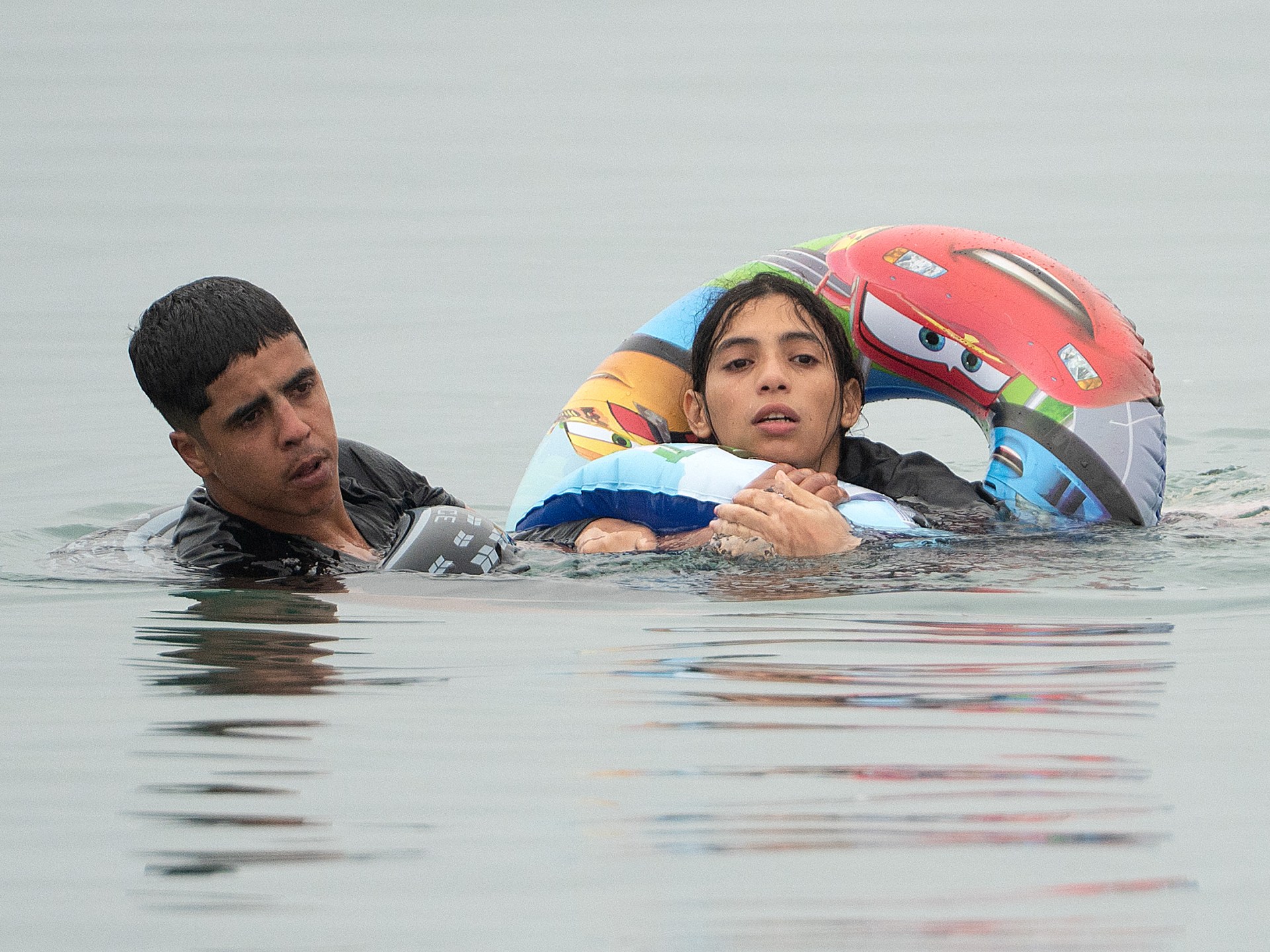
Among the 34 people reported killed, many drowned while attempting the sea crossing while others died in a crush at the breakwater fence near Tarajal beach, according to authorities.
Spanish authorities reinforced the enclave with military personnel and additional police while Morocco deployed security forces and water cannon to push back crowds approaching the border.
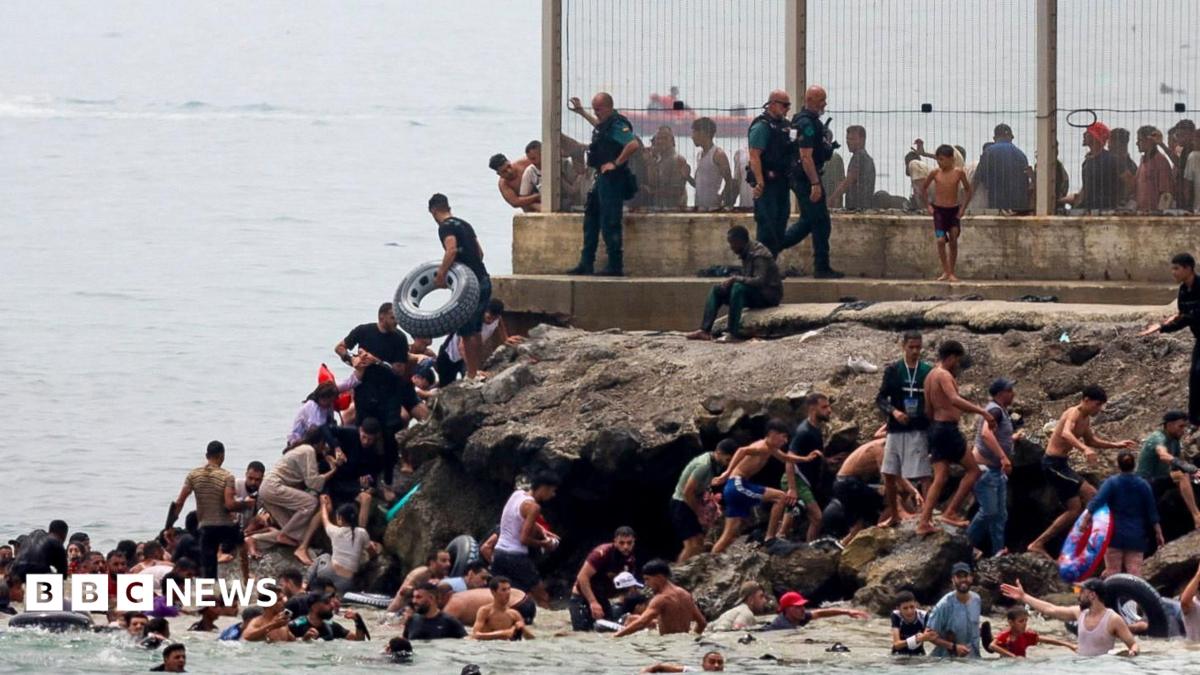
Footage from the Reuters news agency showed large groups of people, mostly young Moroccan men but also families with women and children, moving around the breakwaters and onto roads inside Ceuta.
The remains of a burned bus and seven cars were visible near the border after clashes between security forces and crowds.
Although the main border crossing appeared blocked, groups of migrants continued moving along the coastline, searching for alternative routes, and some prepared to swim around the barriers.
Security forces repeatedly pushed back attempts to breach the crossing overnight, but Reuters footage filmed shortly after 11:30am (09:30 GMT) on Friday showed migrants continuing to enter through the Tarajal beach area despite the reinforced security presence.
Where is Ceuta, and why is it significant?
Ceuta is an autonomous Spanish city on the north coast of Africa bordering Morocco. Along with Melilla, another autonomous Spanish city on the North African coast, it is one of only two land borders between the European Union and Africa.
The territory first came under Portuguese rule in 1415 before becoming part of Spain in 1580. It remained under Spanish sovereignty after Portugal regained independence in 1640.
After the decolonisation of Africa, Ceuta and Melilla remained the only European-held territories on the African mainland. Although geographically in Africa, Ceuta is Spanish territory and forms part of the EU’s external border.
Its location has made it one of the main entry points for migrants and asylum seekers trying to reach Europe. The enclave is protected by high border fences, surveillance systems and a permanent deployment of Spain’s Civil Guard and National Police.
Migrants sometimes try to reach Ceuta by swimming from the Moroccan town of Fnideq, a journey of about 5km (3 miles), while others cross from nearby Belyounech, where the distance is shorter.
Ceuta authorities have linked the latest surge to a Spanish Supreme Court ruling this month that barred authorities from immediately returning migrants who have been intercepted after arriving by sea without due process. The ruling does not apply to people entering by land, including those climbing the border fence.
Some migrant rights activists in Morocco, however, questioned that explanation, saying most migrants would have been unaware of the court ruling.
What has Sanchez said?
Sanchez said his government was mobilising all available resources to respond to the situation and pledged to protect Ceuta’s security.
“Last year, … a reduction of illegal immigration was recorded of around 40 percent; therefore, what happened yesterday breaks with a pattern we had seen consistently, which was reducing illegal flows of migration,” he said on Friday.
“This situation is unexpected,” he added, saying the government would defend Ceuta “as if it were Madrid”.
Asked when migrants would be returned to Morocco, Sanchez replied: “As soon as possible.”
“We have spoken with Moroccan authorities. They are willing to cooperate to facilitate these repatriations of citizens to their country of origin and finally move them.”
He also stressed the importance of working with countries of origin.
“I can understand the situation Ceuta is going through right now, but it’s clear that if we want to … reduce irregular immigration, we need to cooperate with the countries of origin and of transit,” he said.
Referring to the recent Supreme Court ruling, Sanchez said legal changes might be needed “to guarantee these repatriations at the border in the most efficient way possible”.
How has the political response unfolded?
The migrant surge has intensified pressure on Sanchez before next year’s elections as opposition parties accuse his government of failing to control Spain’s borders.
People’s Party leader Alberto Nunez Feijoo wrote on X: “The situation in Ceuta is desperate. The government cannot look the other way … because we are facing a national security crisis.”
Earlier on Thursday, Ceuta’s mayor, Juan Jesus Vivas, also of the People’s Party, called on Madrid to declare a state of emergency.
Santiago Abascal, leader of the far-right Vox party, described the crossings as “an invasion” and blamed Sanchez’s government.
Meanwhile, other European countries have voiced their own concerns. European Commission President Ursula von der Leyen said: “The images coming from Ceuta are unacceptable. We cannot allow anyone to come to our union without abiding by our rules. Dangerous crossings must stop immediately. Smuggling networks must be dismantled, and returns must be swift, as our rules allow.”
France announced tighter controls on its border with Spain. Interior Minister Laurent Nunez said he had “given instructions to immediately step up controls at the Spanish border” and activated rapid intervention border units to carry out more intensive inspections.
In Italy, Prime Minister Giorgia Meloni said her government was prepared to take “extraordinary measures” if necessary.
“Italy will not stand by and watch,” she said. “We are convening the relevant bodies, and following these meetings, we are prepared to intervene with extraordinary measures to defend the borders and the safety of citizens, including the suspension of the Schengen Area with Spain.
“On illegal immigration, we will not yield an inch: Defending the borders, stopping human traffickers and ensuring effective repatriations will continue to be the line of this government.”
Antonio Tajani, Italian deputy prime minister and minister of foreign affairs, went a step further, calling for “closing the Schengen Area to Spain”.
However, former EU foreign policy chief Josep Borrell said such a move would not be legally possible. “Under EU law, no Member State can unilaterally suspend another’s participation in Schengen,” he wrote on X.
“That option simply does not exist in the legal architecture of the Union.”
Borrell said the episode illustrated how some European governments were increasingly invoking EU law in ways that were “in manifest breach of the principle of loyal cooperation that binds them”.
“It is quite revealing of how EU governments are learning to understand, talk, use and abuse the EU’s legal order,” he said.