The number nobody wants to say out loud
The Knot’s annual survey puts the average U.S. wedding in 2024 at around $33,000, and a separate industry tracker now puts the typical ceremony and reception closer to $36,000 once hidden line items are added. Couples in major metros routinely cross $50,000, and weddings in the top ten markets push past $70,000 once you stop and add the rehearsal dinner, the morning-after brunch, and the honeymoon you were already planning to take. If you have ever looked at those numbers and quietly panicked, the panic is appropriate. It is also fixable, but only if you plan from a real number, not from the curated fantasy that lives on social media.
What “wedding budget” actually means
Every couple in a financial podcast will tell you to “set a budget first.” That is true and useless advice, because almost nobody explains what a budget is. A budget is the total amount of cash you can actually spend without borrowing, dipping into retirement, or skipping an emergency fund contribution. Take your combined take-home pay over the next twelve months, subtract rent, utilities, groceries, debt payments, retirement contributions, and the normal operating cost of your life. Whatever is left is your real ceiling. If that number feels insulting, lower your expectations until the number matches the budget instead of the other way around.
The five line items that quietly eat 80% of the budget
Track what couples actually spend, not what they say they will spend, and you will find the same five categories dominating every wedding. Venue and catering run 45 to 55 percent. Photography and videography run 10 to 15 percent. Attire, flowers, and decor eat another 8 to 12 percent. Music and entertainment, including a DJ or band, take 7 to 10 percent. The final 15 to 20 percent covers everything else: invitations, favors, transportation, marriage license, the officiant, hair and makeup, and the small things that no spreadsheet can fully capture. Knowing these percentages matters because it tells you where cutting actually saves money. Trimming the guest list by twenty people often saves more than eliminating the entire floral budget.
The guest list is the real budget
If you remember nothing else, remember this. Every other line item on the budget is downstream of one number: how many people you invite. Catering is priced per head. Invitations are priced per envelope. Favors are priced per setting. A wedding for 80 guests costs meaningfully less than a wedding for 120, often by fifteen thousand dollars or more, with every other detail held constant. The couple who wants to splurge on a signature cocktail, a photobooth, or a custom dessert table should do the math in reverse. Decide what you want, divide by per-head cost, and let that number set the guest list, not the other way around.
What to skip, what to keep, and what to fake
Some traditional line items now have almost no value. Printed save-the-dates are redundant when the invitation itself goes out eight weeks early. Chair covers transform a chair into the same chair with a piece of fabric over it. Champagne towers photograph beautifully and waste a bottle of wine for every six guests. Other items are worth keeping even when budget is tight. A good photographer matters more than almost anything else, because the photos are the only thing you keep for fifty years. A real officiant matters because a ceremony you actually remember is what makes the day mean something. Food and drink matter because hungry guests are miserable guests.
For everything in the middle, the answer is to fake it. Candles under five dollars each at a wholesale site look identical to candles the planner marked up at thirty. Costco flowers arranged by a friend the night before can outshine a florist who charges four times as much. A Spotify playlist with the right transitions costs nothing and, candidly, sounds the same to most guests as a $2,000 DJ. The trick is to pick two or three things to splurge on and then quietly downgrade everything else. A guest will never notice the difference between a hand-folded napkin and a starched rental, but they absolutely will notice whether the food was warm and the music was loud enough to dance to.
How to negotiate with vendors without being unpleasant
Almost every line item is negotiable, and most couples never ask. Venues compete on slow weekdays; ask about Friday or Sunday rates, off-season months, and brunch weddings that often run 30 percent less than Saturday nights. Photographers will quote a base package, then quietly drop it when you mention a competing bid. Caterers price by the plate, and that price has a soft floor. Even florists will work with you on greens versus blooms. The trick is to be polite, specific, and willing to walk away. Vendors respect engaged couples who have done their homework far more than they respect couples who simply accept the first number. A few hours of email back-and-forth can save the cost of a used car.
The cost mistakes that put couples into debt
- Taking a loan “for the wedding.” If you cannot pay cash, scale the wedding. A wedding financed by a personal loan at 12 percent APR will cost roughly twice its real price over five years.
- Ignoring the rehearsal dinner. Often forgotten in the budget, often $1,500 to $4,000 by the time you feed the wedding party plus out-of-town guests the night before.
- Tipping blind. Vendors expect gratuity. Catering staff, bartenders, the officiant, the day-of coordinator, and the valet all want tips. Budget 3 to 5 percent of vendor cost just for tips.
- Forgetting alterations. Dress alterations routinely run $300 to $800, suit tailoring another $200 to $400. Build this into attire from day one.
- Skipping wedding insurance. For around $200 to $400 you can insure the day against vendor bankruptcy, severe weather, or a key illness. The couples who skip it and then face a cancellation lose everything.
What a sane, debt-free wedding looks like
A wedding paid in cash, sized to your actual savings, with no financing and no honeymoon loan, will feel smaller than the version on Instagram, and it will feel better. Couples who go this route consistently report less stress, better guests, and a marriage that starts without a credit card balance. The day is not the venue. The day is not the dress. The day is the people in the room and the fact that you chose each other on purpose. Spend accordingly.
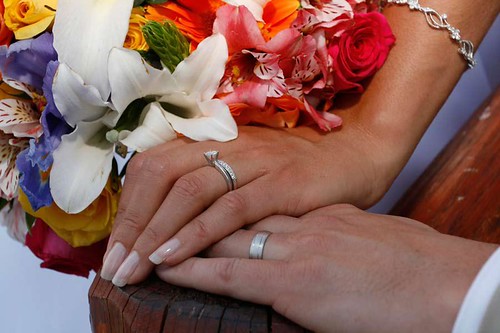
Featured image: “Wedding Rings Hands” by Grand Velas Riviera Maya via Flickr, licensed under CC BY-SA 2.0.