Why Appliance Pricing Has Stopped Making Sense
Walk into a home improvement store on a Tuesday and a “sale” refrigerator costs $1,299. Drive past the same store two weeks later and the identical model is $1,499, marked down from $1,799. Three months after that, it’s $1,099 “while supplies last.” The list price, the sale price, and the actual price you pay have been decoupled for at least a decade, and the only people who consistently win are the ones who treat the purchase like a negotiation, not a transaction.
Major appliances – refrigerators, washers, dryers, dishwashers, ranges – are now a category where the sticker is fiction and the extended warranty pitch is the real profit center. Big retailers have turned white goods into a high-margin, low-attention category, and the customers who do well are the ones who show up with a model number already chosen and a target price in mind. Here’s how to actually pay fair money for one in 2026.
The Markup Most People Don’t Realize
Big-box retailers routinely run 30-40% margins on white goods, and the floor-model “open box” units are sometimes the same physical units with a different color tag. Independent appliance dealers can undercut them by 10-20% on mid-range models because they have lower overhead, and they often throw in free delivery and old-unit haul-away that the chains charge $80-$160 for.
Four concrete tactics that work:
- Quote the lowest price you find online (even if it’s a different retailer), then call the local independent dealer and ask if they can match it. Most will, especially if you mention you’re paying cash or financing through their store card.
- Ask the chain salesperson what their “best price” is before they ring it up. The first price is the anchor; the second is the one they actually wanted to charge.
- Check the manufacturer’s scratch-and-dent or “outlet” section. Cosmetic dents on the side of a fridge you’ll never see save 25-40% with the same factory warranty.
- Avoid the stainless steel “upgrade” mid-purchase. The premium finish on a mid-range washer can run $150-$300 extra; the actual mechanicals inside are identical.
The Extended Warranty Math That Sells Itself (Wrongly)
A 5-year extended warranty on a $1,200 washer runs $180-$280 at the register. The same coverage bought independently from a third-party provider like Upsie or Asurion costs $60-$110. The retailer version also usually excludes the components most likely to fail – control boards, ice makers, smart features – while the third-party version covers them. The retailer warranty exists because it pays the salesperson a 25-40% commission on the day of sale, not because the protection is unique.
Skip the retailer pitch entirely and buy standalone coverage if you want it. Or skip it altogether if the appliance has a 10-year compressor or drive-motor warranty (most mid-range and premium models do), which covers the failure that actually bankrupts the unit. Statistically, a well-reviewed mid-tier appliance fails less than 10% within ten years; you’re paying a $200 premium to insure against a $400 worst case, and the insurer knows it.
When to Buy What: The Calendar and Sale Cycles
Appliance sales follow a predictable rhythm:
- Late September through November: New-model clearance pricing hits 25-35% off last year’s units. The models don’t actually change much year to year – you’re paying for a software tweak and a new model number.
- Black Friday weekend: The “doorbusters” are real on basic models (entry-level washers, gas ranges), but the higher-end units get smaller discounts than the everyday price in October. Inventory on the high-end is also limited; the chain gives you a “great deal” on a model they can’t move.
- Memorial Day and Independence Day weekends: Mid-tier clearance pricing, with extra haul-away and delivery promos stacked on top. These are the second-best sales of the year.
- End of month or end of quarter: Sales staff have quotas. Walk in on the 28th and ask for “your best price on a floor model” – you’ll often get 15% off on the spot because they need to hit number.
The worst time to buy: the week after New Year’s through mid-March, when new inventory arrives and last year’s models are gone. Pay full list price and watch the salesperson commission themselves a vacation.
The Repair-vs-Replace Threshold
If your existing appliance dies, the 50% rule still holds: spend no more than half the replacement cost on a repair. Above that, you’re throwing good money after bad, because a major component failure on a 7-plus-year-old unit usually means more failures are queued up behind it. A 9-year-old fridge with a failed compressor is a fridge whose water filter housing, ice maker, and door gasket are also wearing out.
Before you replace, get two repair quotes. Many independent repair techs charge $80-$120 for a diagnostic that gets credited against the repair. If the compressor or sealed system fails on a fridge, the repair is $500-$900 and a new mid-range fridge is $900-$1,400 – so replacement wins on a 7-year-old unit but repair wins on a 3-year-old one. As a rule of thumb: fridge repairs under $400 are worth it on any unit under 8 years; dryer repairs over $350 on a unit over 10 years aren’t.
The Five Questions to Ask Before You Swipe
Before you commit, get answers to these:
- What’s the actual delivery fee, and does it include haul-away of the old unit? Many “free delivery” promos exclude stairs, second floors, and disposal.
- What’s the return window if it doesn’t fit or doesn’t work? Thirty days is industry standard; anything less means you’re eating a 15-25% restocking fee on a $1,500 fridge.
- Is the model on recall? Search the model number at CPSC.gov before you buy. A “great deal” on a recalled dishwasher is not a great deal.
- What’s the compressor or motor warranty versus the parts warranty? Ten years on the compressor and one year on parts means the manufacturer is betting the cheap parts fail first.
- What does the yellow EnergyGuide sticker say for the actual yearly operating cost? A $200 more efficient fridge saves you $30-$50 per year in electricity – the math works out, but only over 7-plus years.
The cheapest appliance is the one that runs for fifteen years without a service call. The most expensive is the one that fails in year four because you let the salesperson talk you into the wrong model. Buy on the math, not on the floor model’s lighting.
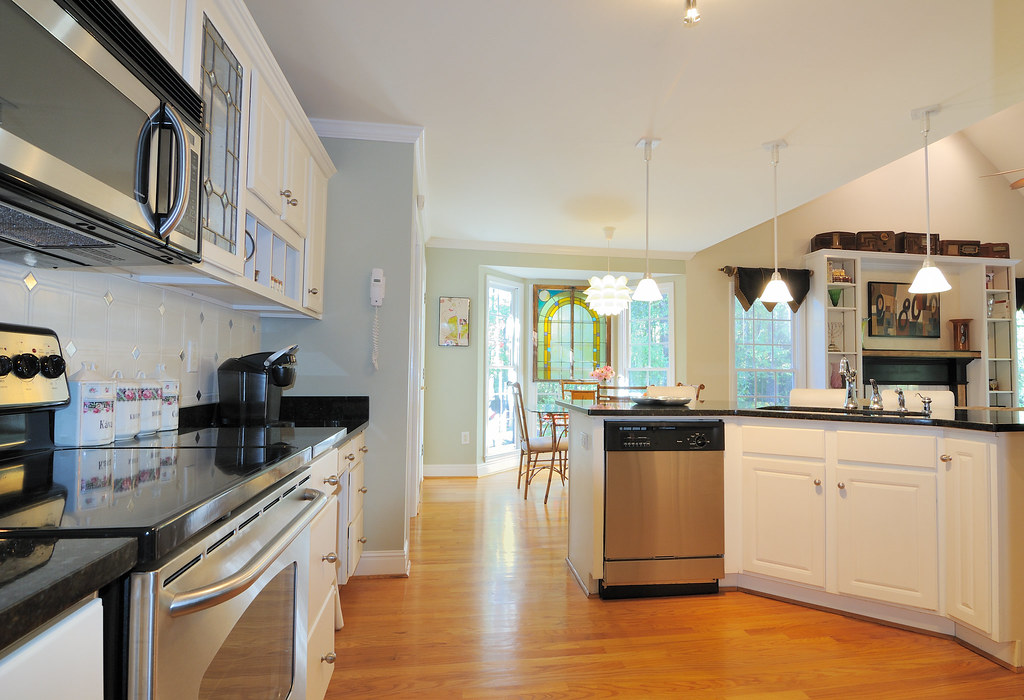
Featured image: “Modern Kitchen” by Foto Miki Digital, via Flickr, Public Domain Mark 1.0.