Why your bill keeps climbing even when usage looks the same
If your utility bill has been quietly climbing for three years while your habits have not changed, you are not imagining it. The average U.S. household paid roughly 25% more for electricity in 2024 than in 2020, and rates in many states have continued to push higher through 2026 as utilities pass along grid upgrades and fuel costs. You can do nothing different inside the house and still owe more at month-end.
Most of the loud advice on this topic pushes you toward a heat pump, new insulation, or a solar sales rep. Those are real options for some households, but none is the first move. The first move is figuring out what you are actually being charged for. The fixes below are things a renter or homeowner can do in a weekend without signing anything.
Read the bill before you touch a thing
Pull up your last three bills on the utility website. You want three numbers: the kilowatt-hours you used, the per-kWh price, and any fixed monthly fees or riders.
Two things tend to jump out within five minutes. First, the per-kWh charge is almost never constant. Many utilities charge more during peak hours (late afternoon into early evening) and less overnight, so if you are on a flat default rate you are subsidizing the people who shifted their laundry to 11 p.m. Second, there are line items most people never look at: a “delivery charge,” a “capacity charge,” a “grid modernization fee,” sometimes a renewable rider. Some are legitimate; some are the utility collecting for storm repairs or programs you never opted into.
If anything looks unfamiliar, call the utility and ask for a line-item walkthrough. Customer-service reps will explain each charge in plain language; this is a regulated conversation, not a negotiation. In many states you can also ask for a tariff sheet, the formal document listing every rate the utility is allowed to charge. Tariff sheets expose fees you can sometimes opt out of.
Set the thermostat like you mean it
Heating and cooling account for roughly half of residential electricity and gas use in most climates, so the thermostat is doing most of the work. The Energy Department and most utility auditors have converged on the same numbers: in winter, set it to 68°F while home and awake, and drop it 7 to 10 degrees when asleep or out. In summer, 78°F when home, higher when out. Each degree of setback saves about 1% on heating and cooling costs over a season, so a disciplined 8-degree overnight setback is roughly a 5 to 8% reduction on annual heating and cooling energy, often $150 to $300 a year for a typical detached house.
The cheapest upgrade that multiplies this is a thermostat you will actually program. A $50 basic unit you set once and leave alone outperforms any $250 learning device that requires you to fiddle with an app. If you rent and cannot change the wall unit, a $25 smart plug on a portable heater or a $15 plug-in thermostat for a window AC automates the same setbacks without modifying anything the landlord cares about.
Lighting, vampire loads, and the small stuff that compounds
Swapping every bulb for LED is no longer novel advice, but the savings still surprise people. A 60-watt equivalent LED uses about 8 to 9 watts and lasts 15 to 25 times longer than the bulb it replaced. If you are still running incandescents or halogens in the five or six fixtures that get the most use, replacing them pays for itself in under a year. Skip specialty bulbs; basic 2700K LEDs from any hardware store are good enough.
Vampire loads are the second low-effort category. Anything with a standby light, a wall wart, or a “remote-ready” label is drawing power 24 hours a day. An entertainment center, a gaming PC, a row of network gear, and a fish tank can quietly pull 100 to 400 watts continuously. A $25 smart power strip that kills the peripherals when you turn off the main device is a meaningful line item.
Heating and cooling on the cheap
Before any contractor walks in your door, there is a stack of low-cost moves. Seal the obvious air leaks with weatherstripping and outlet gaskets. A $20 tube of caulk around window frames, door frames, and where pipes come through the wall is often more impactful per dollar than blown-in insulation. Clean or replace the HVAC filter; a clogged filter can cut efficiency by 5 to 15% and shorten equipment life. Vacuum the refrigerator coils, and make sure supply vents are open while returns are not choked by rugs.
In summer, draw the shades on west-facing windows in the afternoon; in winter, do the opposite and let the sun warm the rooms. Ceiling fans do not cool the air, but they make a room feel 4°F cooler, which lets you raise the AC set point. Run them only when someone is in the room; a fan in an empty room is just motor electricity.
The rate side of the bill
Once your usage and the house itself are in good shape, look at the rate you are paying. Many utilities offer a free time-of-use plan that charges less overnight and on weekends and more during peak hours. If your household can shift laundry, dishwashing, and EV charging off-peak, you can usually beat the default flat rate. Some utilities also offer budget billing, which averages your annual cost into even monthly payments; this is not a discount, but it removes the January surprise.
If you are shopping for a supplier in a deregulated state, read the Electricity Facts Label, which breaks down the actual price per kWh, the contract length, and any early-termination fees. Promotional rates often jump 30 to 50% after the introductory period, so do the math on the full contract term before signing anything.
A 30-day plan you can finish without a contractor
Week one: pull your last three bills, identify the per-kWh charge, fixed fees, and any riders you do not understand, then call the utility and ask. Week two: program the thermostat, swap the five most-used bulbs to LED, and put a smart strip behind the entertainment center. Week three: weatherstrip one exterior door, caulk the worst window gaps, and replace the HVAC filter. Week four: run the numbers again and decide whether a time-of-use plan or budget billing fits your life. None of this requires a permit or a salesperson, and combined it typically cuts a household’s annual energy bill by 10 to 20%, the range the Department of Energy and most utility auditors report when households actually follow through.
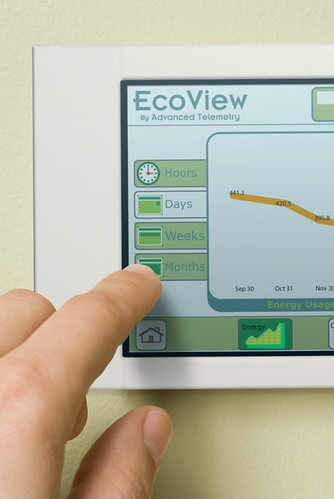
Image: “thermostat-02” by Advanced Telemetry, licensed under CC BY 2.0. Source: https://www.flickr.com/photos/36521980095@N01/6903037213