Every year, travelers lose hundreds of dollars to fees that look small in the moment. A 3% foreign transaction fee on a $4,000 trip quietly hands the credit card company $120 for the privilege of swiping. Dynamic currency conversion at an airport ATM can cost another $80 to $200 on a single withdrawal. Add stacked ATM surcharges, hotel “convenience fees,” and the spread on airport kiosk rates, and a two-week international trip can quietly bleed $300 to $600 you didn’t plan to spend.
This guide walks through the actual money traps waiting for you abroad — and the moves to make before you leave so almost none of that money ever leaves your account.
The Three Traps That Cost the Most
Travel money traps fall into three buckets. Know which one you’re in and you can almost always avoid the cost.
1. Foreign Transaction Fees (FTF)
This is a flat percentage — usually 1% to 3% — added to every purchase you make in a foreign currency. It’s charged by your bank or card issuer, not the merchant. The fee applies whether you tap, swipe, insert, or pay with your phone. The only way to avoid it is to use a card that doesn’t charge one.
Most travel-focused credit cards (Chase Sapphire, Capital One Venture, Amex Platinum, and many no-annual-fee cards) waive the fee. The debit card from your local credit union almost certainly doesn’t. Check the disclosures — look for “foreign transaction fee” or “international transaction fee” — before you leave.
2. Dynamic Currency Conversion (DCC)
This is the trap nobody warns you about. When you pay a foreign merchant or pull from a foreign ATM, the terminal may ask: “Pay in dollars or in euros?” Choosing dollars sounds convenient, but it’s a worse exchange rate plus a fee — typically 3% to 7% on top of the real rate. The bank running DCC pockets the spread.
The fix is mechanical: always choose the local currency. If the terminal won’t let you, cancel and find another merchant. Never let a stranger at a currency exchange or hotel desk convince you “dollars are easier.” Easier is the most expensive word in travel finance.
3. ATM Withdrawal Fees (and the Stacking Problem)
When you pull cash from a foreign ATM, three fees can stack: your bank’s foreign ATM fee (often $5 plus 1%–3%), the ATM operator’s fee ($3 to $5), and the exchange rate spread baked into the conversion. On a $200 withdrawal, that’s $15 to $30 gone before you spend a cent of the cash.
The fix is to withdraw larger amounts less often (so the flat fees amortize) and to use a card that refunds ATM fees — the Charles Schwab investor debit card, for example, reimburses unlimited foreign ATM fees with no monthly minimum.
The Cards and Apps That Save You Real Money
For Purchases: A No-FTF Credit Card
You want a card with no foreign transaction fee and a competitive exchange rate. Most major issuers buy the wholesale rate and pass it through. Don’t pay 3% on a debit card when a Chase Sapphire or Capital One card does it for free.
Cards worth considering in 2026:
- Capital One Venture Rewards — no FTF, decent sign-up bonus, 2x miles on everything.
- Chase Sapphire Preferred — no FTF, transfer partners often worth more than cash back, modest annual fee.
- Bank of America Travel Rewards — no FTF, no annual fee, a sensible backup if you don’t want to play the points game.
- Amex Platinum or Gold — both waive FTF; most lower-tier Amex cards do too.
For Cash: A Fee-Refunding Debit Card
For places that only take cash (street markets, small restaurants, tipping), pair a no-FTF debit card with one that refunds ATM fees. The Schwab investor debit card is still the standout in 2026 — no monthly fee, no FTF, unlimited ATM fee rebates worldwide. You do need a Schwab brokerage account, which has no minimum, so open one before the trip.
Wise and Revolut also offer multi-currency debit cards with competitive rates, though their fee structures have shifted toward small per-transaction charges for less common currencies. Read the fine print before relying on them as your only card.
Five Things to Do Before You Leave
- Call your bank. Tell them where you’re going and the dates. Otherwise, your card may be frozen at the first foreign transaction as a fraud precaution — usually at the worst possible moment.
- Check the FTF disclosure on every card in your wallet. If you don’t see “no foreign transaction fee” in the benefits summary, assume you’ll pay 3%.
- Download your bank’s app. You’ll want to freeze a card instantly if it’s lost or skimmed — and you will want to.
- Set a “no DCC” rule. Every time a terminal offers to charge you in dollars, choose the local currency. Always.
- Plan your cash needs. Withdraw in two large chunks instead of five small ones so flat fees amortize.
Scripts That Save Money When Things Go Sideways
If a merchant or terminal insists on charging you in dollars, you have more leverage than you think.
- At a card terminal: “I’ll only complete this transaction in [local currency]. Please cancel and start over, or I’ll use a different card.” Most terminals default to DCC; the merchant can usually switch.
- At an ATM: If the screen says “Do you accept the conversion rate? 1 USD = 0.91 EUR + 5% fee,” decline and look for a bank-branded ATM, which usually runs a fair rate.
- At a hotel desk: Decline politely and use an ATM or your card instead. The hotel rate is among the worst you’ll find anywhere.
The Bottom Line
Travel money traps are predictable, well-understood, and almost entirely avoidable. The 20 minutes you spend setting up a no-FTF credit card and a fee-refunding debit card before a trip will save you more than the 20 minutes you’d spend hunting for the nearest working ATM in a foreign airport at midnight. Foreign transaction fees, dynamic currency conversion, and stacked ATM charges aren’t hidden — they’re just ignored. Once you know what they look like, you stop paying them.
On a $5,000 two-week international trip, avoiding these traps puts roughly $200 to $400 back in your pocket. On a $15,000 family trip, it’s $600 to $1,200. The math compounds every year you travel, and the savings travel with you.
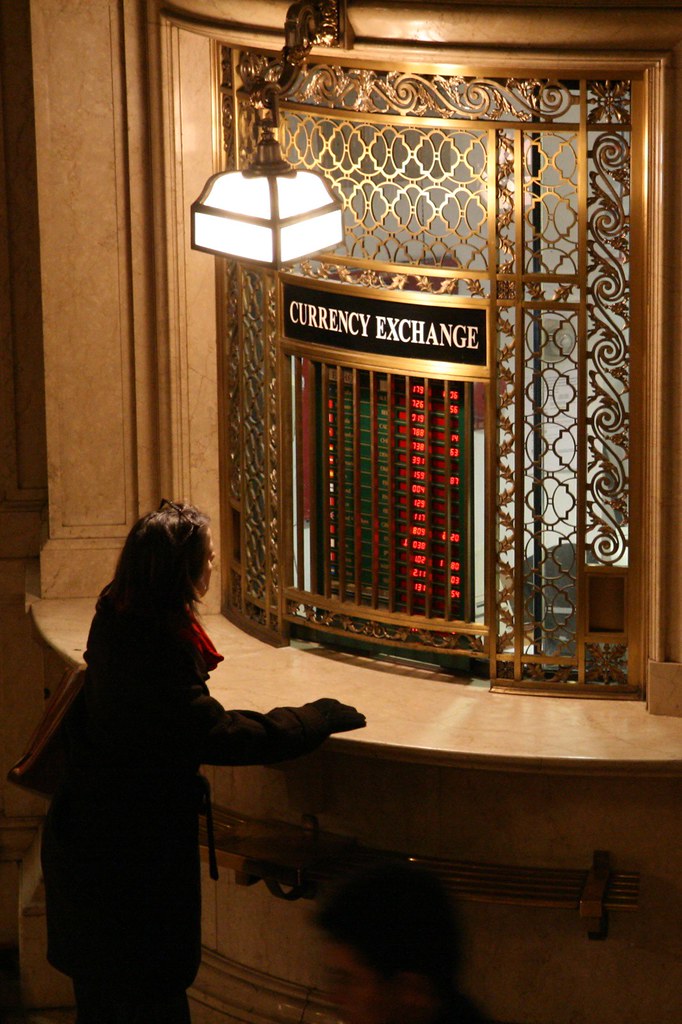
Featured image: “U.S. Exchange Rate -7%, Pearson International Airport, Toronto, Canada” by gruntzooki, licensed under CC BY-SA 2.0.