The 20% Rule Is a Lie (Or at Least, It’s a Starting Point)
Every home renovation guide will tell you to add 20% to whatever your contractor quotes, as a buffer for surprises. The number is not wrong. It is just not enough anymore. In 2026, with labor shortages, tariff-driven material price swings, and permitting delays in most major metros, the realistic buffer on a mid-range kitchen or bathroom remodel is closer to 25–30%. On older homes, especially anything built before 1980, plan for 35%.
Whatever you do, do not borrow that buffer. If your contractor’s bid is $40,000, you need to have $50,000 to $53,000 in cash or pre-approved financing before the first demo day. Borrowing only the bid, then pulling out a second loan when the plumber discovers 1962 galvanized pipes behind the wall, is how homeowners end up paying for the same renovation twice in interest.
Get Three Real Bids, Not Three Calls
There is a difference between three estimates and three bids. An estimate is a number a contractor writes down after walking through your kitchen once. A bid is a line-itemed quote, broken into labor, materials, permits, demo, disposal, and a clear payment schedule tied to milestones. Always ask for the latter, in writing, with a defined scope of work attached.
Cheap bids are usually cheap because they are missing things. Common omissions:
- Permit fees (your responsibility, but many contractors fold them in)
- Haul-away and dump fees for demo debris
- Subcontractor markups (the GC’s plumber may be 30% over what you’d pay direct)
- Allowances for fixtures, tile, and finishes that are unrealistically low
- Cleanup and final walkthrough punch-list time
When comparing bids, normalize them. If one contractor’s number is lower but their tile allowance is $8/sq ft and another is $18, that gap could be $4,000 once the tile is actually picked. Ask each bidder to use the same allowances, or at least to spell theirs out clearly.
The Payment Schedule Tells You Who’s Healthy
Healthy contractors ask for 10–15% up front, milestone draws during the project, and 10–15% retainage held until punch list is complete. Anyone asking for 30–50% before the first nail is hammered is either desperate, undercapitalized, or planning to use your deposit to fund someone else’s job. In states with strict contractor laws (California, Florida, Texas, New York, most of New England), there are legal caps on deposits for a reason.
Never pay the final draw until the work is done, the city inspector has signed off, and you have copies of every warranty, lien waiver, and permit closeout document. The day the contractor hands you the keys is the day you have the least leverage. Get everything in writing before that final check clears.
Where the Money Actually Goes
On a $50,000 mid-range kitchen remodel in 2026, the rough breakdown usually looks like this:
- Cabinetry: 30–35%
- Labor (carpentry, plumbing, electrical, tile): 25–30%
- Appliances: 12–15%
- Countertops: 8–10%
- Flooring and tile: 7–10%
- Design and permits: 5–7%
- Lighting, hardware, miscellaneous: 5%
If the numbers you are being quoted look dramatically different from this, ask why. Cabinets and labor should always be the two biggest line items. If a contractor is quoting a “cheap” kitchen where appliances cost more than cabinets, the cabinets are likely particleboard with a photo of wood.
Financing Without Going Broke
Cash is the cheapest option if you have it. After cash, the next-cheapest sources are usually:
- Home equity line of credit (HELOC): Variable rate, interest often tax-deductible, but tied to your house as collateral
- Home equity loan: Fixed rate, similar tax treatment, lump sum upfront
- Cash-out refinance: Makes sense only if you are already refinancing and rates have dropped
- Contractor financing: Almost always the most expensive option, with rates of 9–14% baked in
- Credit cards: Reserve for under $5,000 of finishes, and only if you can pay it off inside the 0% intro window
Personal loans are usually a worse deal than a HELOC for projects over $15,000, because they are unsecured, so the rate is higher, and the interest is rarely deductible. The exception is when you do not have enough equity to qualify for a HELOC, which is increasingly common as home prices outpace paid-down balances.
The Three Numbers That Keep the Project Honest
Track these in a shared spreadsheet, updated weekly, with every receipt scanned and uploaded:
- Original budget by category
- Committed-to-date (signed contracts plus open purchase orders)
- Spent-to-date (actual money out the door)
When committed-to-date exceeds original budget in any category, you have two choices: cut something, or move money from another category. The third choice, “we’ll figure it out later,” is the one that doubles a renovation budget by the end of the project.
What to Skip
A few upgrades reliably do not pay you back when you sell, and many are not worth the splurge even if you stay:
- High-end appliances: A $9,000 range and a $3,500 range cook the same meals. Mid-range is the sweet spot.
- Heated bathroom floors: Lovely, but $1,500 to install versus the $200 space heater you can plug in when your feet are cold.
- Custom cabinet inserts: Pull-out shelves, lazy Susans, and drawer dividers add 25–40% to cabinet cost. Aftermarket organizers from a big-box store work almost as well for one-tenth the price.
- Built-in coffee systems: A $800 machine on the counter does the same job as the $4,000 built-in, with easier repairs.
Save the splurges for things you touch every day: the kitchen faucet, the cabinet pulls, the shower head. Those are the items that quietly shape how the space feels, and the cheap versions of them age badly.
When to Walk Away From a Contractor
Red flags that mean cut your losses and find someone else, even if a project is already underway:
- Requests for additional payment not in the original scope, with no written change order
- Job site sits empty for more than two weeks with no explanation
- Refuses to provide lien waivers from subcontractors
- Asks you to pull the building permit “under your name to save money”
- Suggests cash discounts to dodge the contract paperwork
Firing a contractor mid-job is expensive and disruptive. It is almost always cheaper than letting a bad one finish. Lien waivers are the single most overlooked protection: a sub who is not paid by your GC can put a lien on your house, and you can end up paying twice. Get them at every draw.
A renovation that ends 20% over budget is a budget failure. A renovation that ends on budget is a planning success. The first one happens to most people. The second one happens to people who plan the budget the same way a small business plans cash flow: deliberately, weekly, and with a clear definition of done.
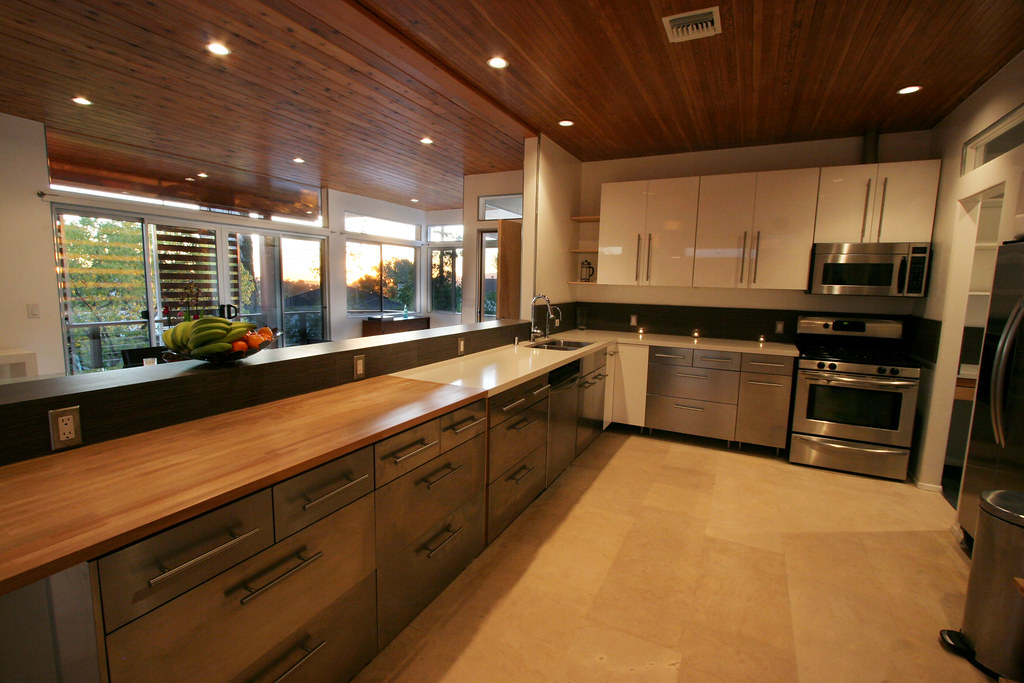
Image: “Kitchen” by Jeremy Levine Design, via Flickr, licensed under CC BY 2.0.