Getting locked out is one of the few consumer emergencies where you stand outside your own home, unable to leave, and a stranger sets the price. That combination produces a small, well-worn set of price games. Most collapse if you spend five minutes on the phone before anyone drives out.
What a locksmith actually costs
Four things explain almost all of the price variation: time of day, geography, urgency, and whether your door has to be drilled.
A standard residential lockout during business hours in a mid-cost city runs $75 to $150. The same unlock at 11 p.m. on a Sunday commonly runs $150 to $400, and in high-cost coastal markets those upper numbers get crossed routinely. Rekeying one deadbolt cylinder is usually $40 to $90 in labor plus $15 to $30 for the cylinder. A full deadbolt replacement, hardware and labor together, lands between $200 and $500.
The number that should worry you is a quote far below those ranges.
The dispatch layer is why the phone price is fiction
Most “24-hour locksmith” numbers you see online are not the locksmith. They are a dispatch center that takes your call, then bids the job out to whichever independent operator is free and fastest to answer. The company on the truck may differ completely from the one you dialed, and the accountability you thought you had evaporates after the first handoff.
This is why the quoted price so often changes on arrival. The person on the phone was bidding a job they don’t control, and the technician in front of you is looking for work that isn’t on the ticket.
The three bait-and-switch moves, named
- The mystery high-security lock. The technician examines your deadbolt for ten seconds and announces that it’s a restricted brand that must be drilled or replaced, at several times the quoted price. Most residential cylinders are standard and readable from the keyway in seconds. If a lock truly requires destruction, get a specific price for that action first.
- The trip fee inflation. The number you agreed to was the labor. The trip charge, service call, after-hours surcharge, and fuel surcharge get layered on at the door. All of that should have been in the number you agreed to.
- The “your door is damaged” upsell. A bent strike plate or a cylinder that turns without throwing is sometimes genuinely worn. It is also a convenient opening for a $600 upgrade nobody asked for at midnight. Ask what specifically is broken and whether it affects security.
Six questions that force a real quote
Ask before anyone is dispatched, and write the answers down.
- “What’s your total price, all in — labor, parts, trip fee, after-hours, and tax?” Then ask them to text it to you. A refusal to put a number in writing is the clearest warning sign there is.
- “What’s your license or registration number?” Real shops have one. Many states require locksmiths to be licensed or bonded, and some cities require a permit number.
- “Are you the company that will do the work, or a dispatch service?” This single question eliminates a large share of bad options.
- “Do you charge if you can’t get in?” Some do. Know it before they pick the lock.
- “Will you try a non-destructive entry first?” A competent technician works the lock before touching the door, and will tell you whether drilling is even an option.
- “Do you mark up the hardware?” A fair number of shops make more on the parts than on the labor.
Rules for the doorstep
- Never authorize drilling, sawing, or cutting until you have a specific price for that action. Drilling saves the lock and can destroy a solid wood or fiberglass door and its frame. A $180 job becomes a $900 door.
- Never pay up front by cash app, gift card, or wire transfer. Anyone who wants payment before touching the lock is not a locksmith.
- Ask for an itemized invoice before you pay. If the total exceeds what you agreed to, nothing gets paid until it’s settled in writing.
- Hold your ID up to the window instead of handing it over. It verifies the person before you open the door.
Prevent the emergency instead of pricing it
- Keep a spare key with a neighbor, a family member, or in a lockbox bolted to the house. Not in the fake rock, not under the planter, and never on a spare-key magnet, which advertises your address to anyone who looks twice.
- Write the brand and model of your lock on the inside of the door jamb with painter’s tape. It costs nothing and turns a possible drill job into a thirty-second cylinder swap.
- Save two local locksmith numbers now, while you are calm. Prefer a shop with a real street address and a named owner over a national 24-hour line that farms calls out to strangers.
- If you rent, find out who handles lockouts before you need to know. In many leases it is the landlord’s job, and an after-hours bill you paid yourself is money you can recover with one text message.
Rekey or replace: where the real savings are
If you are locked out of a working door, you need a rekey, not a replacement. Rekeying keeps the existing hardware and swaps the cylinder, usually $100 to $250 for a front door with two or three locks, and it makes every key you had stop working.
Replacement is the right call in a narrower set of cases: the lock is physically damaged, you are deliberately upgrading to a higher security grade, or the hardware is old enough that a new cylinder inside it would be wasted money. Buying a $30 deadbolt at a hardware store and paying a locksmith $40 to $60 to install it is a legitimate way to spend less, as long as you do not need the door open within the hour.
The ten minutes after you get the keys
Rekeying is the cheapest security upgrade in the house, and skipping it is expensive. When you move into a rental or buy a house from someone, rekey the front door, the back door, and every exterior deadbolt, roughly $100 to $250 for the set, rather than replacing hardware you have not verified. Change the code on any smart lock, garage remote, or mailbox lock that came with the property.
One exception on a rental: rekey, but leave the lock bodies exactly where they are. Landlords can bill you at move-out for hardware you changed without permission, and a rekey leaves their cylinders in place.
The honest version is simple. Emergency lockout work is expensive because it is genuinely urgent and genuinely skilled, and nobody should expect a $25 unlock. The goal is to pay a fair price for a real professional exactly once, and never to stand at your own door twice for the same lock.
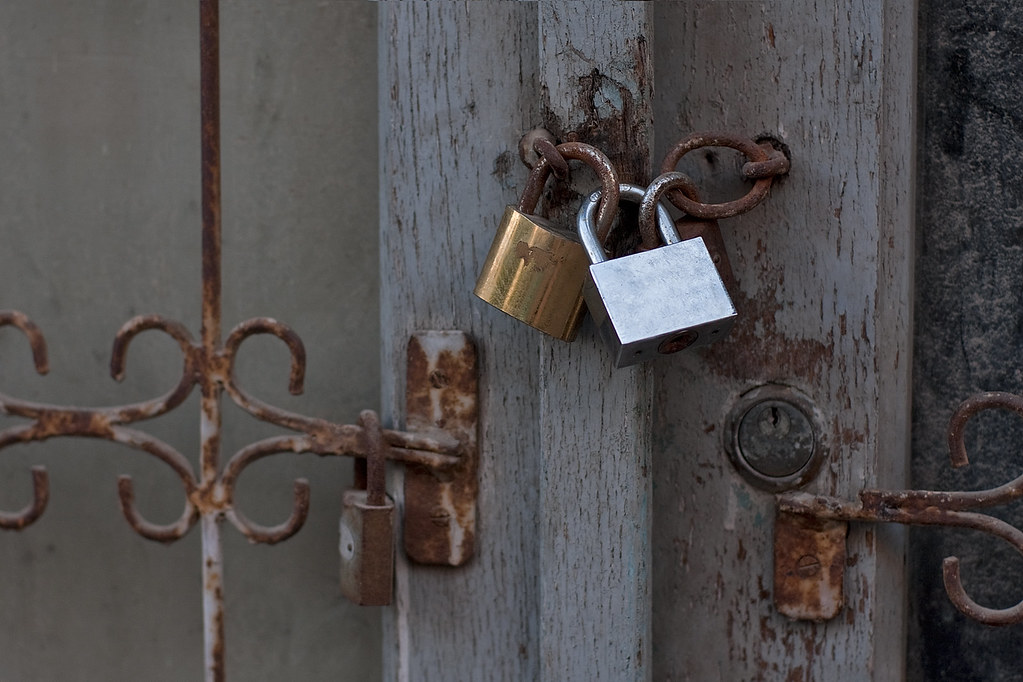
Image: “Couple of metallic padlocks on old door frame” by Horia Varlan (Flickr), licensed under CC BY 2.0.