Somewhere between the boat lot and the first winter, most new owners discover the number that was never on the sticker: the one that keeps running after the boat is parked. A boat is not a car with a hole in it. It depreciates faster, it needs a place to live that costs money even when nobody touches it, and it can be financed on a term long enough to outlast your credit score. Almost every bad boat purchase goes wrong the same way: a loan that runs too long, a storage bill nobody budgeted, and a payment that survives the resale.
Run the real math before you fall for the payment
Dealers advertise the monthly payment, and the payment on a ten-year boat loan can look almost comically small. A $45,000 boat at 8% over ten years comes out to roughly $545 a month. That number is technically true and practically useless, because it assumes the boat is still worth $45,000 in 2036. It will not be. A well-maintained 22-footer commonly loses a third to half of its value in five years.
The comparison that matters is not the payment but the cost per hour of use. At a realistic 40 hours a year, that $545 payment is $13.60 an hour before fuel, insurance, storage, or maintenance. Add the rest and a modest family boat passes $50 an hour.
- Price — the negotiated out-the-door number, including trailer, electronics, and a fair price for the boat you already own
- Loan term — anything past seven years is a warning sign, not a feature
- Fixed annual costs — storage, insurance, winterization, registration
- Variable annual costs — fuel across 30 to 50 hours, plus a maintenance reserve
Pick a loan term you can actually live with
Marine lenders will happily write you a ten-, twelve-, or fifteen-year loan, and buyers sign for them constantly, because a longer term flatters the only number anybody compares. The lender earns more the longer you borrow, and the collateral is depreciating the whole time. Run a different test: estimate what the boat will be worth to you in five years — call it 50 to 60% of purchase price for a mainstream powerboat — subtract what you would still owe, and ask whether you would want the boat if you were $12,000 underwater. If the answer wobbles, shorten the term or buy something smaller.
Two details catch people. Try to put 20% down: below that threshold many lenders require a personal guarantor, meaning the balance can be pursued against your income after repossession. And insist on a fixed rate, because a variable-rate loan can adjust upward mid-payment, on an asset that no longer supports the balance.
The two-year-old boat is the deal dealers never advertise
The standard advice about factory “demo” units at a discount is half wrong. Dealers discount demos to clear inventory, but a demo boat has hours on it, and many manufacturers exclude demo units from warranty — precisely the coverage the discount was supposed to buy you. The genuinely good value is a two- to four-year-old boat from a large marina or a used-boat broker: the first owner absorbed the steepest part of the depreciation curve, the boat still has most of its useful life, and any remaining factory warranty may be transferable. What you should not do is buy a fifteen-year-old fiberglass hull at a price that assumes no mechanic’s invoice is coming. Stringers, transoms, and engine mounts fail with age at least as much as with hours, and those repairs are labor-heavy.
Storage is a second mortgage, and it starts before launch
First-time buyers price the boat and forget to price the place it lives. Most boat owners do not keep it on their own property, so storage is a permanent line item, not a seasonal expense.
- Dry storage — usually the cheapest credible option, often roughly $15 to $25 per foot per season in warmer regions
- Wet slip or marina — the premium option, often several hundred dollars a month in season, capped by boat length, frequently bundled with dock power
- Trailer storage or a home lift — cheapest if you have the land and the tow vehicle, but a boat plus trailer needs parking space year round
Before signing, call three facilities with your boat’s exact length and ask for the annual total including electricity, liveaboard rules, and pump-out fees. Add winterization on top: in cold climates it runs into the hundreds every year.
Insurance is two decisions, and only one of them is obvious
Boaters routinely buy minimum liability and skip the rest. Then a storm drops a tree across the boat, the claim pays the pre-collapse value, and the owner is left covering the difference between that check and the boat he now has to replace. The fix is agreed value coverage — hull insurance, agreed value hull, or whatever the carrier calls it. It names a dollar figure in the policy and pays that figure on a total loss. The alternative, actual cash value, is a depreciated payout that leaves you buying back the same boat at today’s prices.
For anything you keep more than a few seasons, agreed value is the line worth paying extra for. Take the USCG-approved boating safety course before you buy the policy rather than after — it is one of the cheapest discounts available anywhere in this market. And ask the marina what its certificate of insurance requirement is: slips frequently demand far more liability than a personal policy carries, and that number belongs in your storage comparison.
Budget the running costs like a second vehicle
Fuel is the obvious expense: a mid-size outboard burns real gallons per hour. Three other line items are the ones first-time owners underestimate.
- Maintenance — a small annual percentage of the boat’s value covers impellers, hoses, batteries, anodes, and the annual service visit
- The trailer — it is a vehicle with a boat attached, and tires, bearings, lights, brakes, and registration keep billing you after the boat is paid off
- Your own hours — washing, waxing, draining, and winterizing are real time, which is why some honest owners buy less boat and use it more
Know when not to buy
The cheapest boat is the one you do not buy yet. If your answer to “where does this live” is “I will figure that out,” you are one season away from paying off-season rates and still short the down payment. If the only deadline is a birthday or a rental that ends, that is the same pressure that produces a fifteen-year loan and a storage contract nobody read aloud.
Buy when you have a named storage place at a real price, a down payment that leaves your emergency fund intact, a term under about seven years, agreed value insurance lined up, and an honest estimate of the hours you’ll use it. Any blank space, and the boat will still be there next season — for less.
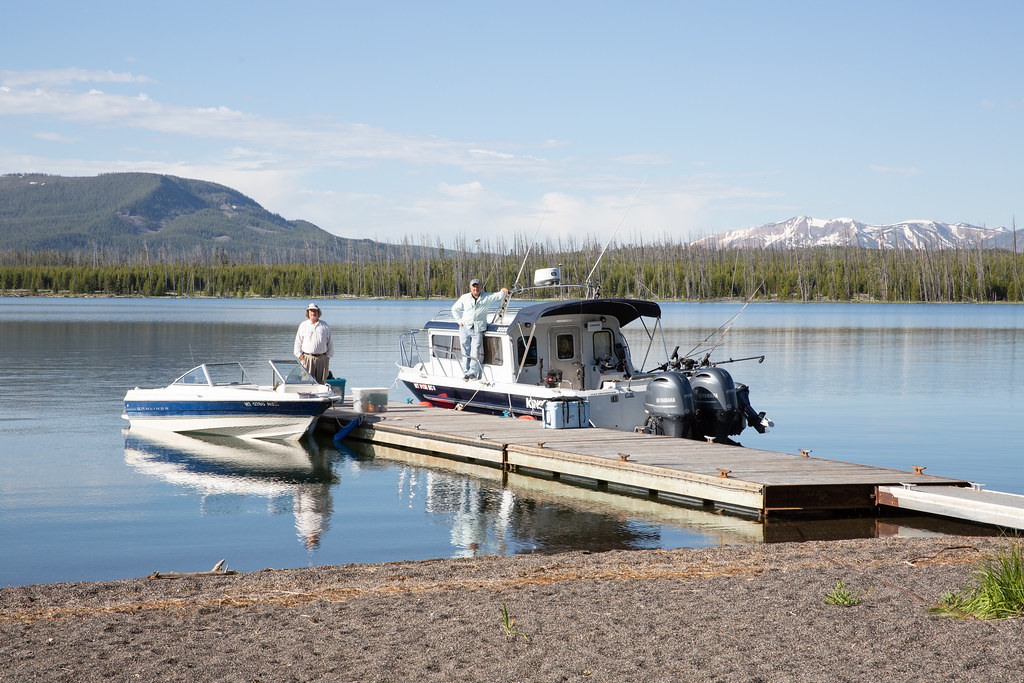
Image: “Motorboats docked at Wolf Bay” by YellowstoneNPS, via Flickr, marked with a Public Domain Mark 1.0.