The average American driver spends somewhere between $600 and $1,400 every time they replace a full set of tires, and most do it the same way: a slow leak, a drive to the nearest shop, and whatever the counter guy suggests. That is the worst way to spend $1,000. Tires are one of the few purchases where thirty minutes of homework can save a third of the bill, but almost nobody does the homework because the topic feels opaque and the urgency feels real.
Why tires are such an easy mark
Three things work against you. First, urgency. A bald tire is not something you can negotiate over for a week. Second, vocabulary. The sidewall is stamped with digits that read like alphabet soup. Third, the sales floor. The person behind the register earns a commission, gets a spiff on certain brands, and is trained to keep you focused on tire price instead of total price.
The most important sentence in this article: always ask for the out-the-door price, including mounting, balancing, valves, and any fees, before you say yes. The sticker on the wall is not the price you will pay.
The four numbers on the sidewall that matter more than the brand
Look at any tire on your car right now. On the sidewall you will see a string like 215/55R17 94H. That is almost everything you need.
- 215 is the width in millimeters.
- 55 is the aspect ratio; the sidewall is 55 percent as tall as the tire is wide.
- R means radial construction, the standard since the 1970s.
- 17 is the wheel diameter in inches. Match exactly; your wheels will not accept a different diameter.
- 94 is the load index. Match or exceed it.
- H is the speed rating. Match or exceed it; H covers 130 mph, V 149, W 168.
If your car came with run-flats, you can usually switch to standard tires and save $80 to $200 per set, as long as you carry a spare or have roadside assistance. Most drivers never notice the difference.
Brand matters less than people think. The mid-tier lines from Michelin, Continental, Goodyear, Bridgestone, and Pirelli test within a few percentage points of their premium siblings. Independent testing consistently shows a $130 mid-tier tire performs at roughly 90 percent of a $220 premium tire on what actually matters: wet braking, snow traction, tread life. The premium is mostly the name, the sidewall design, and a softer compound that wears faster.
New, used, or retread — the real tradeoff
New is the obvious answer and the right one for most drivers. A new tire from a major manufacturer carries a mileage warranty (typically 40,000 to 80,000 miles), full tread depth, and a DOT date code you can read.
Retread tires, also called “remanufactured” or “recycled,” are casings buffed down and re-capped with new tread. They are legal, regulated, and common on commercial trucks. For passenger cars, quality retreads from reputable shops can be a real bargain at 40 to 50 percent off new, but the casing has unknown history and most warranties do not apply.
Used tires are a different animal. The DOT serial ends with four digits: week and year of manufacture. Anything over six years old has aged out regardless of tread depth, because the rubber hardens and becomes brittle. A $50 used tire that fails at highway speed costs far more than a $130 new one.
When to buy — and why the blowout is the most expensive moment
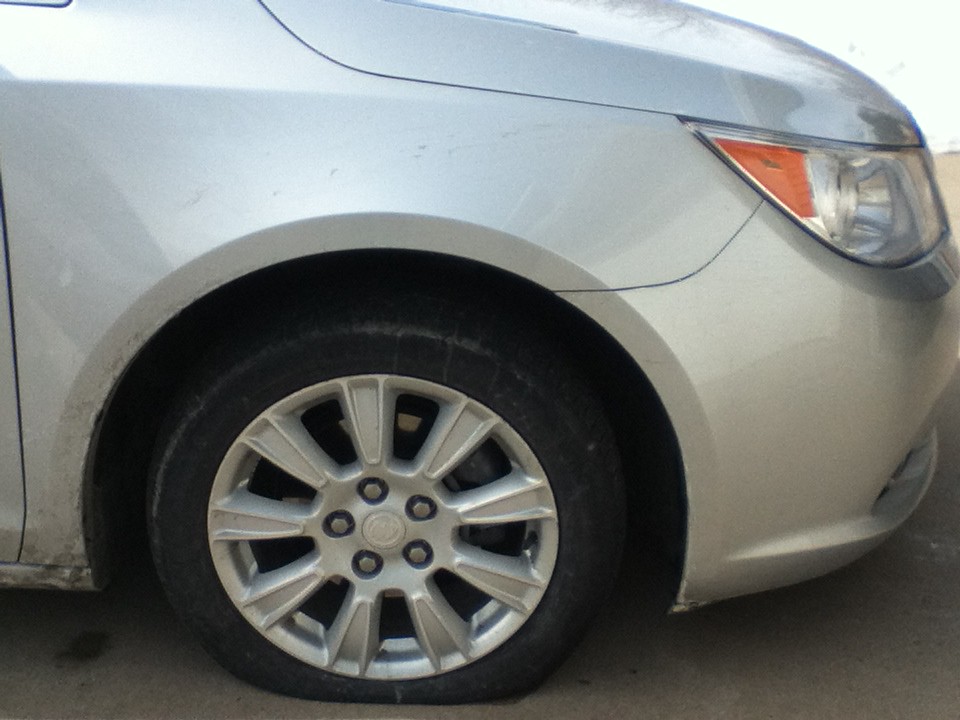
The cheapest moment to buy tires is one to two weeks before you need them. The most expensive moment is the day you discover you need them.
Late fall is when shops discount winter and all-season inventory to clear shelf space. Late spring is when they discount winter tires. Discounts are real, often 20 to 35 percent off, but the inventory is what it is.
The penny test is a fine sanity check: insert a Lincoln head-down into the tread; if you can see the top of the head, replace the tire. But it misses two things: age and uneven wear. A tire with ten years on it is dangerous. A tire worn more on one edge than another usually means an alignment problem no amount of new rubber will fix.
Replace in pairs, ideally all four. Mismatched tires on the same axle behave unpredictably under hard braking. If you can only afford two, put them on the rear, not the front, even on a front-wheel-drive car. Losing the rear end is harder to recover from than losing the front.
The moves shops hope you don’t try
Get three quotes. Online retailers (Tire Rack, Discount Tire Direct, SimpleTire, Amazon Tire Connect, Costco if you are a member) routinely undercut local shops by 20 to 30 percent on the same tire. Most local shops will install customer-supplied tires for $20 to $30 per wheel. That is the leverage you have.
Skip the road-hazard warranty. It costs $15 to $25 per tire and pays a prorated amount toward replacement if you damage a tire. A warranty costs $20; the payout is typically 50 percent of remaining tread life. You are paying for damage you statistically will not have.
Skip the lifetime tire rotation. It usually costs $20 to $40 per tire up front, and even if you rotate every 5,000 miles for the life of the tires, you would have paid roughly $40 in rotations a la carte over that period.
Ask for the line-item quote. Tire, mounting, balancing, valve stems, disposal fee (usually $2 to $5 per tire, legitimate), shop supplies (usually $3 to $8 per tire, mostly profit). When the line items are visible, the negotiating room appears.
Be polite and walk away once. Tire pricing has more slack than almost any other retail category. If the quote is $900 and you think it should be $750, say so. The worst answer is “no.” Most often, you get a counter at around $800.
The one-page playbook
Read the sidewall code on your current tires before you call anyone. Get three quotes: one local independent shop, one chain, one online retailer. Compare on out-the-door total price, not tire price alone. Match size, load index, and speed rating exactly. Skip the road-hazard warranty and the lifetime rotation package. Buy a mid-tier tire from a major manufacturer unless you have a specific reason not to. Replace in pairs at a minimum, all four preferred, and get an alignment at the same time if the wear was uneven.
That is the whole playbook. It takes about thirty minutes. The savings typically run $200 to $400 on a full set, money you earn by reading a code stamped on a tire and asking a counter clerk to break down a quote.
Image credit: “Tire technician using a compressed air impact wrench to unscrew lug nuts and change a car wheel” by Ivan Radic, licensed under CC BY 2.0.