The $400 most people leave on the table
Most late-year tax advice falls into one of two camps. Either it’s a generic checklist ripped from a TurboTax help article, or it’s a “hack” that saves a typical worker twelve dollars. The honest truth is that for most W-2 earners in 2026, the real money is somewhere in between — usually between $400 and $1,500 a year if you do the boring moves correctly and skip the bad ones.
This is a practical list of the moves that actually move the needle, with realistic numbers, plus the moves that look clever and quietly cost more than they save. If your adjusted gross income is under about $90,000 and you take the standard deduction, a lot of the high-roller advice you’ll see this month doesn’t apply to you. I’ll flag where.
Step 1: Adjust your W-4 if you got a refund
If you received a federal refund above $1,000 last spring, you gave the Treasury an interest-free loan. You can fix that any time before December 31 by submitting a new W-4 to your employer raising your withholding. The IRS Tax Withholding Estimator takes about five minutes and tells you exactly what number to put on the form.
This isn’t technically a “tax reduction” — it’s a cash-flow move — but for most people it’s the single biggest year-end win. A $2,000 refund turned into biweekly take-home means roughly $77 more per paycheck without owing in April.
If you owed money in April, do the opposite. Raise your withholding, or send an estimated payment through IRS Direct Pay before December 31 to avoid the underpayment penalty.
Step 2: Max out your 401(k) if you can swing it
The 2026 employee contribution limit is $23,500, with an extra $7,500 catch-up if you’re 50 or older. Every dollar you put in before December 31 reduces your taxable income dollar for dollar.
For a single filer in the 22% federal bracket, maxing out saves about $5,170 in federal tax. That’s real money. If you can’t hit the full $23,500, even an extra $2,000 in December reduces about $440 off your bill.
One timing note: 401(k) contributions count in the year they’re withheld from your paycheck, not when your employer processes them. If you want 2026 credit, the last paycheck that lands in 2026 is the deadline. Most plans take a few days to land in your account, so don’t push it past December 28.
Step 3: Harvest investment losses before December 31
If you hold taxable investments below what you paid for them, selling them lets you use the loss to offset gains you’ve already realized this year, plus up to $3,000 of ordinary income if you have no gains to offset. Anything beyond that carries forward indefinitely.
The wash sale rule trips people up: if you buy the same or a “substantially identical” security within 30 days before or after the sale, the loss is disallowed. To avoid this, either wait 31 days to buy back in, or buy a similar but not identical fund in the same category — for example, swap one S&P 500 index fund for a total-market fund.
Don’t let loss harvesting morph into “I’ll sell my winners to rebalance.” That’s just rebalancing, not a tax move, and it can create a tax bill instead of saving one.
Step 4: The moves that actually help itemizers
If you take the standard deduction ($14,600 single, $29,200 married filing jointly in 2026), most “deduct this!” articles are wasted on you. Bunching deductions only matters if your itemized deductions already exceed the standard.
For people who do itemize, the real December moves are:
- Bunching charitable gifts: instead of giving $200 monthly to your favorite nonprofits, pay $2,400 in December to push you over the standard-deduction threshold. Nonprofits don’t care about your timing, and your accountant will thank you.
- Paying January’s mortgage payment in December: if you pay your January bill by December 31, you can deduct the interest on this year’s return. Most servicers let you do this once per year without penalty.
- Charging medical expenses on a credit card before the bill posts counts as paid in the year you charge it, not when you pay the card. This matters for people whose medical bills exceed 7.5% of AGI.
Step 5: The moves that quietly backfire
Now the part most articles skip. Three common year-end moves look smart on paper and cost real money in practice:
- Buying a “tax-saver” bond fund in a taxable brokerage. Most yield-bond tax is minimal, and the brokerage fees plus spread eat any benefit. Inside a 401(k) or IRA, fine. In a taxable account, usually a wash at best.
- Taking an early IRA distribution now so you can “deduct the contribution later.” The 10% penalty plus ordinary income tax usually costs more than any future deduction. The carve-outs (first-time home buyer up to $10,000 lifetime, qualified education) are narrow and worth checking before you act.
- Donating appreciated stock you bought six weeks ago to dodge capital gains. Donating long-term appreciated stock is the right answer; donating short-term gain stock triggers ordinary income tax on the gain, wiping out most of the benefit. Stick with cash for short-term holdings.
Step 6: The high-earner moves (skip if AGI is under $200k)
If your AGI is over $200,000 single or $250,000 married, three moves open up that don’t exist at lower incomes:
- Backdoor Roth IRA: contribute the $7,500 limit to a non-deductible traditional IRA, then convert it to a Roth. Watch the pro-rata rule if you have other pre-tax IRA money — it can wipe out most of the benefit. Vanguard, Fidelity, and Schwab handle this cleanly.
- Donor-advised funds: useful if you have a windfall year and want to give appreciated assets while avoiding capital gains. The deduction is immediate; the charity receives the money on your schedule.
- QSBS exclusion timing: if you exercise qualified small business stock held more than five years, up to $10 million of gains can be excluded federally. The five-year clock matters more than any December deadline.
The minimum you should do in the next 60 days
If you only do three things between now and January 1, do these:
- Run the IRS Tax Withholding Estimator. Adjust your W-4 if your last refund was bigger than $1,000.
- Increase your 401(k) contributions by as much as you can sustain for the next eight weeks. Even $200 per paycheck adds up to a meaningful deduction.
- Pull your year-to-date brokerage statement. If anything is at a loss and you have realized gains, talk to your tax software or accountant about harvesting before December 31.
Skip everything else this list doesn’t include. The “tax hack” industry makes its money from people who chase December moves they didn’t need. The real win is doing the boring stuff at the right time and ignoring the rest.
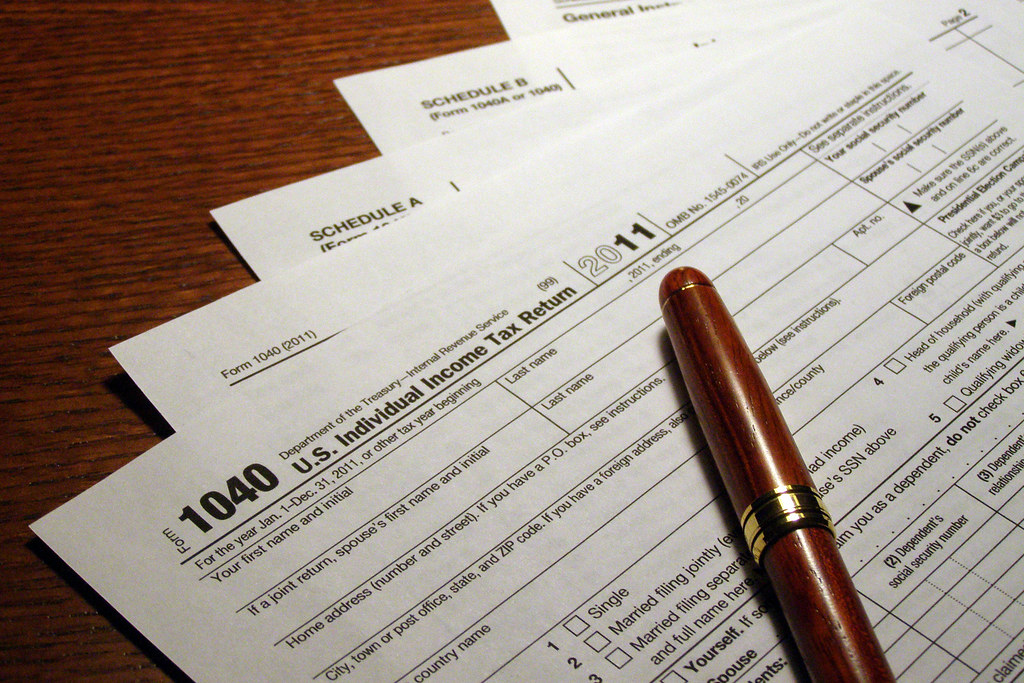
Image: “Personal Income Taxes 1” by ccPixs.com, used under CC BY 2.0. Original: https://www.flickr.com/photos/ccpixs/8194660049