The Markup You’re Actually Paying For
The De Beers “two months’ salary” rule is a 20th-century marketing invention, but the markup it’s used to justify is very real. Industry analysts peg retail diamond markup somewhere between 100% and 300% over wholesale — meaning a stone wholesale-priced at $4,000 typically walks out of a mall store at $8,000 to $12,000. That gap is the store’s rent, sales commission, advertising, and profit, not any difference in the diamond itself.
Two diamonds with the same GIA-certified 4Cs (cut, color, clarity, carat) can carry wildly different price tags simply because one is sold at a chain like Kay or Zales and the other at an independent jeweler buying direct from a cutter. Online retailers such as Blue Nile, Ritani, and With Clarity operate with much lower overhead and routinely undercut mall stores by 30% to 50% on identical certified stones. The product isn’t cheaper — the rent and middlemen are.
The honest benchmark: a GIA-certified 1-carat round diamond, H color, VS2 clarity, very good cut, currently wholesales for roughly $2,800 to $3,500. If a retail quote is above $6,000 for that exact spec, you’re paying for the showroom, not the stone.
Lab-Grown Isn’t a Free Pass, Either
Lab-grown diamonds have demolished the price floor. A 1-carat lab-grown stone with the same 4Cs now runs $700 to $1,200 — a 70% to 80% discount over a mined diamond of equivalent appearance. Chemically and optically they are identical diamond. The difference is provenance, not beauty.
Three things to know before you buy one:
- Resale is awful. Mined diamonds already lose 30% to 50% the moment you walk out of the store. Lab-grown stones lose closer to 80% to 90%. If you ever plan to upgrade or trade in, factor that into the math.
- Disclosure is mandatory. Any reputable seller will laser-inscribe the girdle and label the stone as lab-grown. If a seller can’t produce that documentation, walk away.
- The market is still finding a floor. Prices have dropped about 30% in the last two years as production scaled up. Buy for beauty today, not as a store of value.
Lab-grown is the rational pick if the ring is for romance, not resale. Mined still wins if “investment” or “heirloom” is part of the emotional story — just know the economics behind the emotion.
The Other Costs That Add Up Fast
The stone is the loudest line item, but it’s not the only one. A realistic 2026 budget also covers:
- Setting. $300 to $2,500 for a plain solitaire in 14k gold; $1,000 to $4,000+ for platinum or pavé side stones. Custom work starts around $1,500 and climbs fast.
- Insurance riders. Adding the ring to a renters or homeowners policy runs roughly $1.50 to $3 per $100 of appraised value per year. A $10,000 ring costs $150 to $300 a year to insure — and is not covered by default.
- Resizing. Usually free within the first year, then $50 to $150 if her size changes later.
- Appraisal for insurance. $75 to $150, often refunded if you buy from the same jeweler.
- Lifetime cleaning and prong checks. Many stores include it; some charge $30 to $60 per visit.
Add it together and a “ring budget” is really a “ring plus 10% to 20% in surrounding costs” budget. People who plan for the stone alone end up putting the setting on a credit card.
The Financing Traps That Make the Ring Cost Three Times
Jewelry store “no interest for 12 months” promotions are the most expensive way to buy a ring that doesn’t seem expensive. The mechanics are well known and brutal: if you don’t pay the full balance by the deadline, the store retroactively charges interest on the entire original purchase, often at 25% to 30% APR, from the original purchase date. A $5,000 ring carrying a $1,000 unpaid balance at month 12 can suddenly add $1,200 to $1,500 in deferred interest on the next statement.
Other traps worth naming:
- Store credit cards routinely charge 28.99% or 29.99% APR after the promo ends. That’s higher than most general-purpose rewards cards.
- Lease-to-own outfits (like Progressive Leasing) advertise “$30 a week” but the effective APR is often 100%+.
- “Custom” design deposits are often non-refundable. If you change your mind at the CAD stage, you lose the deposit.
If cash on hand can’t cover it cleanly, save two to four more months. If you can’t wait, a 0% APR balance-transfer card or a personal loan from a credit union (typically 8% to 14%) costs less than almost any jeweler financing.
A Real Budget That Buys Real Beauty
Forget the “two months’ salary” rule. A useful 2026 framework: spend what you can pay off within six months without touching your emergency fund, and aim for a ring whose total all-in price (stone + setting + insurance year one + appraisal) stays under 8% to 10% of your gross annual income. By that math:
- $60,000 income → ring budget up to $5,000 to $6,000
- $90,000 income → ring budget up to $7,500 to $9,000
- $120,000+ income → ring budget up to $10,000 to $12,000
Those numbers buy a beautiful 0.9 to 1.2 carat lab-grown stone in a quality setting, or a 0.7 to 0.9 carat mined diamond of strong cut and color, well within the same showroom-quality tier that bigger chains charge twice as much for.
The Moves That Save Real Money
Five tactics that consistently cut a real percentage off the final bill without lowering the look of the ring:
- Buy the stone online, the setting locally. Online diamond retailers run 30% to 50% under mall stores on identical certified stones. Many local jewelers will set a customer-supplied stone for $150 to $400 and warranty the workmanship.
- Drop one color grade. An I-color diamond looks identical to a G-color diamond once mounted. Save 10% to 15%.
- Pick a “near colorless” fluorescence. Medium fluorescence can lower the price 5% to 10% with no visible effect in most settings.
- Choose a setting that protects the stone. A six-prong or bezel setting costs only slightly more than four-prong and prevents the most expensive type of loss: a lost center stone.
- Insure from day one. A rider costs almost nothing; replacing an uninsured lost stone costs everything.
The point isn’t to spend less on love. It’s to spend less on rent, marketing, and finance charges, so the money goes to the thing that actually lasts.
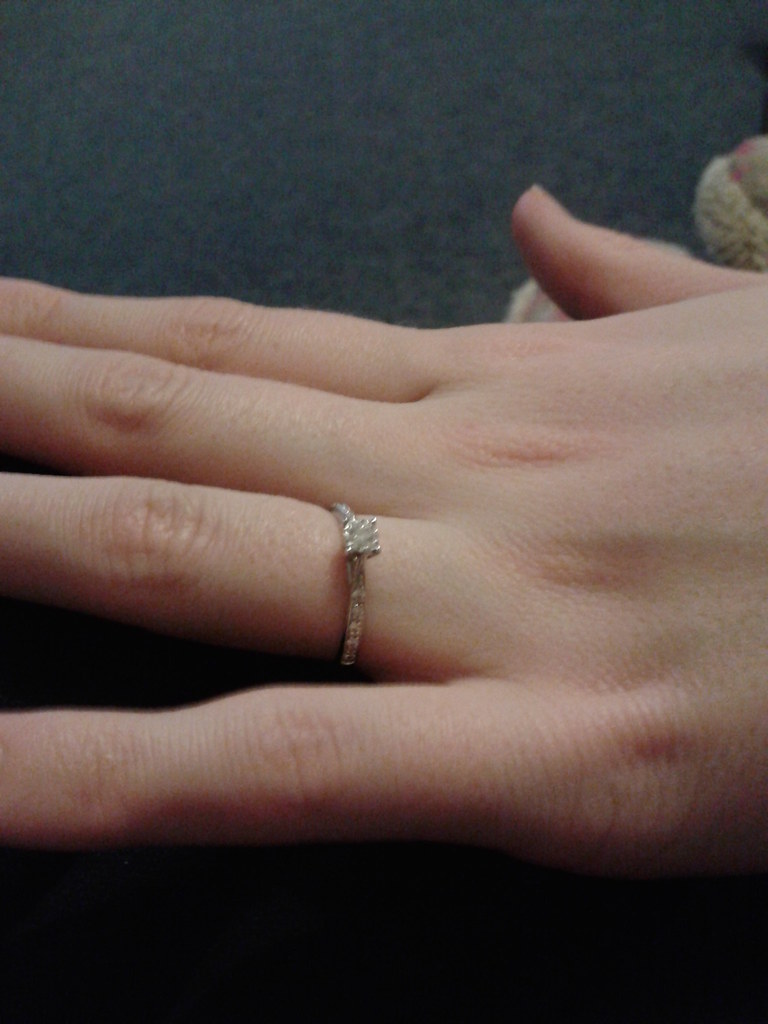
Image: “Engagement Ring” by Prophetic_Blogger, via Flickr, licensed under CC BY 2.0.