For most of the last decade, the residential solar pitch had one number buried inside it: a 30% federal tax credit. That number is gone for installations placed in service after December 31, 2025. Every payback estimate you read before then was built on it.
What that leaves in 2026 is a decision that has to stand on the panels’ actual production and your actual electric bill. It also means the pitch you hear this year may still be quoting the old math, because sales scripts outlive legislation.
The number that changed the whole calculation
The Residential Clean Energy Credit covered 30% of eligible installed cost and terminated entirely for property placed in service after the end of 2025. A $30,000 system that cost $21,000 in cash now costs $30,000. Nothing about the hardware changed. Only the number on your check did.
A system that looked like it paid for itself in 12 years now looks like 18, or worse, depending on your utility and your roof. Any proposal still showing a net cost “after tax credits” was written before 2026, or copied from a template nobody updated.
Run the payback math yourself first
Before you talk to anyone, get two numbers: your utility’s actual annual kWh usage from 12 consecutive months of bills, and the specific per-kWh rate on your rate schedule. Not the state average. Yours.
A worked example: a 10 kW system produces roughly 10,000 kWh a year. At $0.17 per kWh, that is $1,700 a year. At $30,000 out of pocket, simple payback is about 17.6 years. With the old credit, $21,000 would have put you at 12.4 years. That is the entire delta: roughly five extra years of waiting for the same roof.
Cross-check that estimate against a free, independent tool instead of the seller’s. The National Renewable Energy Laboratory’s PVWatts calculator estimates annual output from your address and system size with no pitch attached. If an installer claims 15,000 kWh from a 10 kW array in Ohio, they have not modeled shading.
Net metering decides whether any of this works
This is the biggest single factor, and it varies enormously by state and sometimes by utility. Under traditional net metering, every kWh your panels export is credited at your full retail rate — you are paid $0.17 to send power back to the grid. That makes rooftop solar behave like an electric bill with a ceiling.
A growing number of states have replaced that with net billing, where excess energy is credited at a much lower rate, often a quarter to a half of retail. Change one assumption from $0.17 to $0.06 and the example above drops from $1,700 to about $1,150 a year, pushing payback past 26 years. Same panels, same roof, completely different investment.
Find out your utility’s rules before you sign anything, and require them in writing. “Full retail net metering” and “net billing at a reduced export rate” are not interchangeable.
Cash, loan, lease, or PPA
- Cash. The only option with no interest, no lien, and full access to utility rebates and property-tax treatment, if you can fund it without draining your emergency fund.
- Solar loan. Real financing, usually secured, usually at 6-10%. Watch for a deficiency balance: in many states, if you sell the house or refinance while the loan is outstanding, you can be sued for the entire remaining balance rather than just what the house sold for. California, New Jersey, Nevada, Idaho, New York, and Pennsylvania have restricted or banned this; Utah, Texas, Indiana, and Michigan generally have not. Ask what your state does, and get the answer in writing.
- Lease or PPA. Small or zero upfront, but you do not own the panels, you pay over 20-25 years, most contracts carry a 1.5-3% annual escalator, and in many states the utility rebate and state credit do not come with you. There is always a buyout figure at the end, and it starts high.
“Free solar” door-to-door pitches are frequently the entry point to a timeshare-style recruiting model where you are expected to sell the system to friends, family, and coworkers. That is a sales business, not an investment.
Questions that sort installers quickly
- What is the total price in dollars, and what is it per watt? Get it in writing before the site visit ends.
- What are the exact module and inverter model numbers, and who stands behind the warranty? Warranties from defunct manufacturers are scrap paper — several major panel makers went bankrupt or exited the U.S. market between 2022 and 2024.
- Is there a written production guarantee, and what actually happens if the system underperforms?
- What is my buyout price in year one, year ten, and year twenty-five?
Three protections worth using
First, the FTC’s Cooling-Off Rule now permanently covers door-to-door sales of goods and services over $50, which includes a solar pitch made in your living room. That gives you three days to cancel a contract signed at home, without penalty. If the seller failed to hand you a completed notice of your right to cancel, that window can stretch to a year.
Second, never sign on your own driveway. Nearly every pressure tactic that pushes homeowners into bad financing depends on the signing happening right now, while the crew is loading the truck.
Third, get three written bids before signing anything, and strip the financing out of each. If one installer’s cash price is meaningfully higher than another’s, ask why. Often the answer is that the cheaper one was never going to make money on a loan you were not going to sign.
When solar genuinely does not pencil out
If you expect to move within about seven years, the math rarely works. You are selling a depreciating asset with a lien attached, to a buyer who may have to assume the balance.
If your roof has fewer than roughly twelve good years left, you will probably pay to remove and reinstall panels when you replace it, adding several thousand dollars and months of work.
If you are on a time-of-use rate in a state with low export compensation, or your household usage is small, the system is either too small to matter or too big to cover.
And if a salesperson leads with the federal tax credit, or will not answer the net metering question in writing, walk away. Those are signs you have stopped talking to a solar company and started talking to someone selling a 2023 script.
Solar is still a good deal for a lot of households: high electric rates, a solid roof, twenty years of staying put, full retail net metering, and either cash or a straightforward loan. What changed in 2026 is not whether solar works, but that it has to work on the numbers, without a subsidy that is no longer coming.
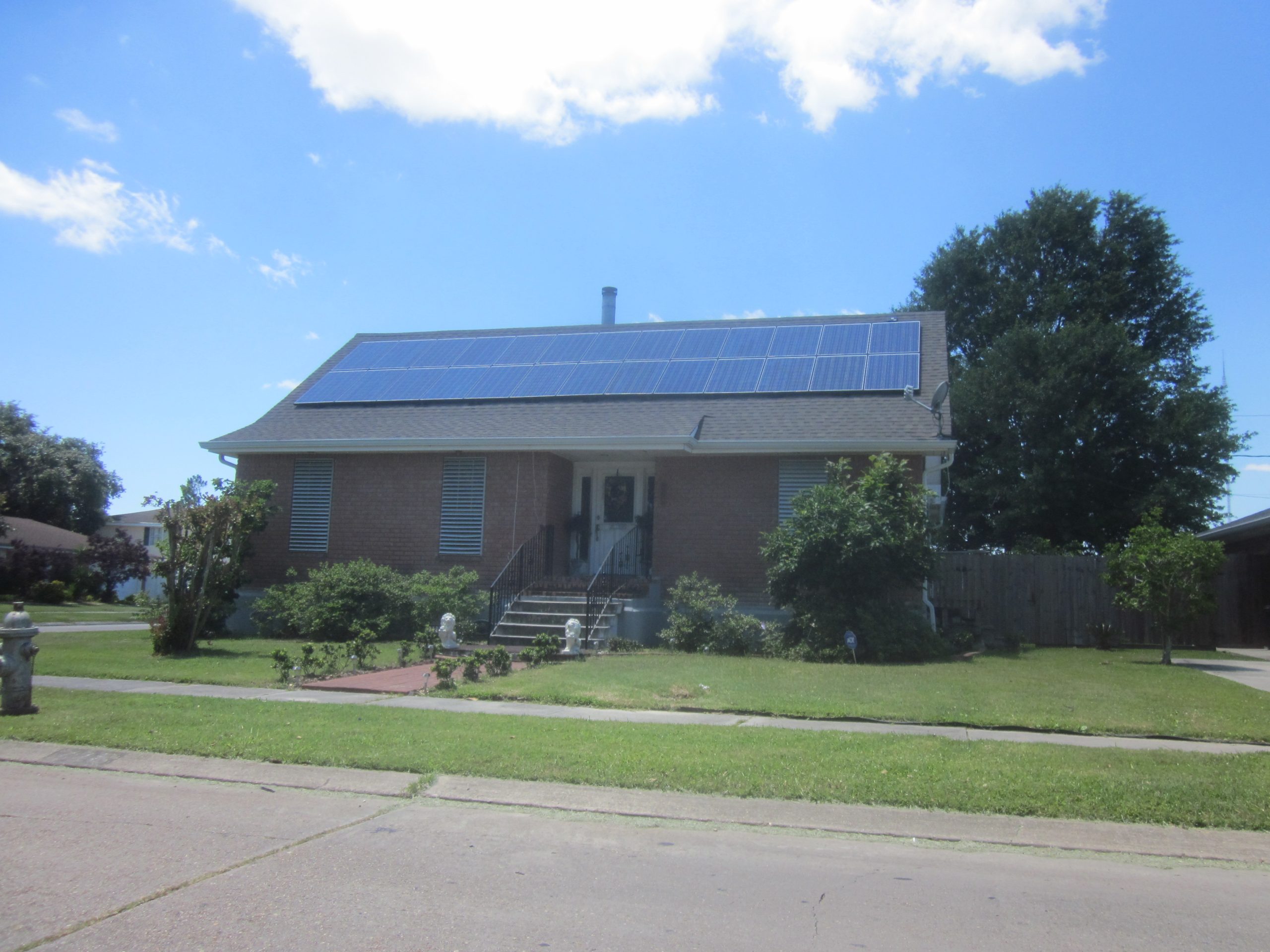
Photo credit: “Terrytown Solar Panel Roof House” by Infrogmation of New Orleans, via Wikimedia Commons, licensed under CC BY-SA 3.0.